Menu

Showing posts with label Zohar. Show all posts

Sunday, 19 July 2026

562) Was Maharal of Prague a philosopher or a veiled mystic?

Tiferet Yisrael by Maharal of Prague. First edition, Venice 1599

Introduction

This articlebased extensively on the research by Dr Leore Sachs-Shmueli and Eynel Kapachexamines the question of whether the Maharal of Prague  (1512-1609) was a philosopher or a Kabbalist. The Maharal has long been the subject of much scholarly debate over his relationship to Kabbalah. This new research situates Maharal as a discreet Kabbalist who hid his deep mystical views behind a veil of philosophy. 

Sunday, 14 June 2026

557) The Roaring Lion returns: A contemporary polemic against Jewish mysticism

The Roaring Lion by R. Leon of Modena

Note: This article examines Jewish mysticism and Kabbalah from a historical, psychological and analytical perspective. If you prefer not to read such treatments of mysticism, you may wish to skip this piece. 

Introduction

This articlebased extensively on the research by Lippman Bodoffexamines the highly contested roots of Medieval Jewish mysticism. I started writing this article twice and then stopped. This was because I know that some of the ideas expressed in it will be challenging to some, particularly in an era where mysticism has become mainstream Judaism. For many (including myself from the early age of thirteen), mysticism, specifically in the incarnation of modern Chassidism, had been the portal through which we returned to Torah Judaism. 

Sunday, 19 April 2026

549) From Serafim to Sefirot: The Kedusha and the rise of human participation in the cosmic drama

The Kedusha in a 1745 Siddur according to the custom of the Arizal

Introduction

This articledrawing extensively on the research by Dr Leore Sachs-Shmueli—examines a fundamental shift in the mystical interpretation of the Kedusha, recited during the communal repetition of the Amidah (standing prayer). The Kedusha, with its liturgy dating to the fifth century CE (Fleischer 1998:305), was understood in early Jewish mysticism—particularly the Heichalot and Merkavah literature beginning from around the second century CE—as an opportunity for earthly worshippers to imitate and mimic the prayers of the heavenly angels who united heaven and earth through their recital of the Kedusha. In this ancient framework, human prayer was conceived as an echo of the primary celestial liturgy. However, with the emergence of the Zoharic corpus in the late thirteenth century (the Zohar first circulated around 1290), a significant theological shift took place. The angels, who were once conceptualised as being central to the Kedusha, were now relegated to the margins, while humanity assumed the pivotal role in a cosmic drama that sought to unite heaven and earth. 

Sunday, 14 December 2025

534) Between Law and Magic: The Mezuzah as a test case in shifting cosmologies


Introduction

This article—drawing extensively on the research of Professor Oded Yisraeli—examines references to the mezuzah from both before and after the emergence of the Zohar in the late thirteenth century, in order to trace shifting cosmologies. To map these changing approaches, we shall examine successive periods of Jewish literature from the third century to our times, each marked by distinct emphases and developments in the evolving mystical cosmology of the mezuzah. 

Saturday, 25 October 2025

527) Neoplatonic echoes in Chassidic Mysticism


Raphael's fresco, School of Athens, painted around 1509.

Introduction

This article explores the intellectual legacy of Abu Ya'qub Isḥāq ibn Sulaymān al-Israeli—also known as Yitzchak ben Shlomo haYisraeli (c.855–c.955)—a pioneering yet largely overlooked figure in early Medieval Jewish philosophy. Through a counterintuitive comparison between Yitzchak haYisraeli’s tenth-century philosophical writings and contemporary Chassidic thought rooted in Kabbalah, the study reveals an unexpected conceptual convergence between the two thought systems. 

Sunday, 17 August 2025

522) Italian letters: The battle over the Zohar

An 1847 letter by Shmuel David Luzatto, to the scholar Meir Halevi Letteris.

Introduction

This articlebased extensively on the research by Daniel A. Klein[1]examines the little-known polemic over Kabbalah between two great Italian rabbis of the nineteenth century. These rabbis were R. Shmuel David Luzzatto (known as Shadal, 1800-1865), a great-grandnephew of the famed R. Moshe Chaim Luzzatto (Ramchal), and R. Elia Benamozegh (1823-1900), the rabbi of Livorno (Leghorn). The two collided in written correspondence—not over Halachah, but over the soul of Judaism itself. Both were outspoken defenders of traditional Judaism, yet each understood its essence in profoundly different ways. 

Shadal emphasised the practical, ethical and rational core of Judaism, rejecting mystical elements like Kabbalah and particularly the Zohar. His approach was more material than ethereal in the sense of being grounded in practical, historical, linguistic, and moral realism. Benamozegh, on the other hand, was a mystic, a Kabbalist, a man who believed the Zohar was not only authentic, but essential. To this day, the Piazza Benamozegh in Livorno, Tuscany, continues to bear his name—a quiet but enduring tribute to the legacy of a man whose ideas once stirred fierce debate within Italian Jewry. 

Sunday, 8 June 2025

513) Secret Mystical and Chassidic societies

The Pledge of Allegiance between the students of the Ari zal (as found in the Stolin Geniza)

Introduction

This article—based extensively on the research by Rabbi Dr Zvi Leshem[1]—examines several secret mystical societies from biblical times to pre-war Europe, with a particular focus on the secretive group established by R. Kalonymus Kalmish (Kalman) Shapira of Piasecnzo (Piasetzna) (1889-1943). 

Secret mystical circles and societies are not well-known in Judaism, but they have always existed. 

Biblical times

The Torah describes the Benei haNevi’im (Sons of the Prophets) who were groups of disciples of prophets like Samuel, Eliyahu and Elisha (see 2 Kings 2:3, 4:1, 6:1 for example). These groups, while not necessarily secretive, played a significant role in preserving prophetic traditions and maintaining spiritual teachings during times of idolatry and apostasy. They used mystical techniques including meditation and even music to train in prophetic inspiration (Leshem 2021:112). 

Sunday, 8 December 2024

496) Kabbalah: To print or not to print the ‘lost’ mystical tradition


The first printed edition, the "editio princeps", of the Zohar published in Mantua, Italy in 1558.


Introduction

This article based extensively on the research by Avraham Oriah Kelman[1] examines the little-known crisis in Kabbalistic transmission that became evident between the thirteenth and sixteenth centuries. 

The earlier Sefaradic Kabbalistic tradition, which had peaked in Spain in the thirteenth century (with the Zohar first published around 1290) had now spread to central Europe. The expulsion from Spain in 1492 can be seen as precipitating this spread of Kabbalistic influence to Europe. This was coupled with the simultaneous spread of Kabbalah from the various mystical schools of Safed, including Lurianic Kabbalah from the Ari Zal (1534-1572). By the sixteenth century, Central European Ashkenazi Jewry was well-exposed to, and keenly influenced by, Kabbalah from both its eastern and western co-religionists. But Kabbalah, although now widely disseminated and popularised, was in an internal state of crisis. This created a tension between the leadership of the mystical movement and those who were publishing mystical works, and it is to that tension and theological strain that we shall now turn. 

Sunday, 27 October 2024

491) A source trail defending the Baal haTanya’s definition of the soul as ‘a part of G-d’


Signature of the Lubavitcher Rebbe in a copy of the Tanya in 1979

Introduction

This article based extensively on the research by Rabbi Dr Louis Jacobs (1920-2006)[1] traces possible sources that the author of the Tanya, R. Schneur Zalman of Liadi, also known as the Baal haTanya (1745-1812), may have used, to formulate what is sometimes described as his ‘controversial’ definition of a soul being an actual ‘part’ of G-d.  

The notion of an infinite and monotheistic G-d who incarnates Himself in humans is often regarded as anathema to Jewish theology which seems firmly against the idea that G-d embodies Himself within mortal beings. Yet, as we shall see, there is an array of earlier mystical sources that the Baal haTanya could, and may, have used to develop his famous statement that the [second or Godly] soul is חלק אלו-ה ממעל ממש, truly a part of G-d above (Tanya, Ch. 2).[2] 

Sunday, 26 May 2024

473) ‘Der Pintele Yid’ − the evolution of the term and concept

Introduction

This article based extensively on the research by Professor Yehuda Liebes[1] examines the theological development of the term ‘Der Pintele Yid.’ We trace the evolution of conceptualisations of ‘energy points’ from emtza (center), to nekuda (point), to Pintele Yud and finally to Pintele Yid. 

Der Pintele Yid is the Yiddish equivalent of haNekuda Yehudi or haNekuda haYehudit, which, in its common usage today, simply refers to an essential ‘point’ of Jewishness that lies dormant within every Jew even the most assimilated and emerges at unexpected times. 

Sunday, 14 April 2024

469) Examining an unpublished manuscript of the Zohar

 Part 2

Abstract

A hitherto unknown manuscript of the Zohar was found in the Vatican Library. It tells the story of R. Yosi and R Aba going on a journey. R. Yosi reprimands R. Aba for not discussing Torah and keeping silent while travelling. R. Aba responds and eventually convinces R. Yosi that silence is a better path to follow. This would have been no minor matter, because the standard practice amongst the characters represented in the Zohar was indeed to travel and speak Torah words. It offered protection and rectification along the way. R. Aba’s path of silence, however, which was based on the importance of silent  Kavanah (concentration) and the fact that he then initiated R. Yosi into that unconventional path of silent Kavanah was seen as a subversive mystical theology. More importantly, R. Aba’s path of silent Kavanah may have represented a counter and threatening spiritualist movement of Kabbalists who opposed the dominating, standard and relatively conservative mystical school of the Zohar, where practice, words and sounds had to be appended to the Kavanah. These politics of theological subtleties may explain why this short manuscript text never made its way into the printed editions of the Zohar. 

Sunday, 10 December 2023

455) The three-pronged mystical revolution of the 16th century


Seventeenth century manuscript of Eitz Chaim by R. Chaim Vital

Introduction

This article based extensively on the research by Professor Rachel Elior[1] and Professor Zvi Werblowsky[2] − examines the three-pronged mystical revolution of the sixteenth century that changed the face of much of subsequent Judaism. 

In general terms, it is true that despite the calamitous events of the fifteenth century which saw the expulsion of Jews from Spain in 1492: 

“[t]he majority of exiles rehabilitated themselves by pursuing a normal life, conducted according to usual mundane considerations” (Elior 2000:187). 

On the other hand, a smaller but very influential number of Jewish mystics saw the world of the sixteenth century as anything but normative. They turned to Kabbalah and mysticism as the only way to explain the trauma of the expulsion. They believed and taught that the world was on the cusp of an imminent messianic redemption. Instead of engaging with the normative world like the majority of their co-religionists which included scholars and rabbis, they sought to detach themselves from reality as they experienced what they believed were the messianic birthpangs. These circles of mystics were known as Mechashvei Kitzim (Calculators of the End). 

Sunday, 22 October 2023

448) R. Yosef Karo’s unusual mystical entries in his diary


1773 edition of Magid Meisharim by  R. Yosef Karo

Introduction

R. Yosef Karo (1488-1575) is well recognised as the great codifier of Jewish law who was responsible for the Shulchan Aruch. Many are familiar with the logical and methodical nature of this legal code. For practical purposes, today, he is widely regarded as the last of the great codifiers if not the codifier par excellence. 

However, not many are aware of an extremely mystical component of his makeup. This extreme mysticism may seem rather surprising for someone so steeped in the pragmatism of legal codes. He kept a diary in which he recorded some of the mystical teachings he had acquired from an apparent spiritual or angelic being, known as a Magid (who identified as the ‘soul’ of the Mishna). These were later published in book form under the title Magid Meisharim. 

Sunday, 13 August 2023

441) Could the Zohar Chadash have engaged in a contemporary polemic with Chassidei Ashkenaz?

Introduction

This article, based extensively on the research by Dr Jonatan Benarroch,[1] explores the question of whether Zohar, could possibly have engaged in a polemic, or religious debate, with the Chassidei Ashkenaz (the German Pietists of the Rhineland). The problem is that the Zohar is traditionally believed to have been authored by R. Shimon bar Yochai, a second-century Tanna, or Mishnaic rabbi while Chassidei Ashkenaz was a twelfth and thirteenth-century mystical movement in Germany. This places the Zohar a thousand years before the advent of Chassidei Askenaz. 

Sunday, 27 February 2022

373) Kabbalah – a product of the East or West?


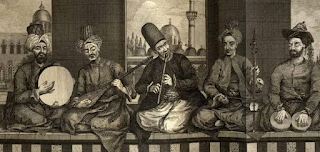
Jews and Sufis shared music traditions

Introduction

Kabbalah, until just a few decades ago, was generally understood in as originating within a Eurocentric context. It was believed to have emerged essentially from centres like Italy, Provence (southern France), Germany and Spain. In scholarly circles, this was the result particularly of the work by Gershom Scholem,[1] who was convinced of Gnostic origins to Kabbalah: He writes that it is:

surprising that the [Kabbalistic][2] doctrine…was deeply related to Gnosticism, but such are the dialectics of history” (Scholem 1941:286).

Sunday, 13 February 2022

371) ‘Tikla’ and the zoharic concept that sin can bring redemption


The potter's wheel gives shape to a lump of clay.

Introduction

This article, based extensively on the research by Dr Ruth Kara-Ivanov Kaniel[1] as well as Rabbi Moshe Miller[2], deals with the fascinating yet paradoxical notion in the Zohar of sin as a harbinger or precursor of redemption. The discussion revolves around the Aramaic word Tikla, which appears on two occasions in the Zohar.[3]

Sunday, 30 January 2022

369) Menachem Tziyoni’s kabbalistic writings on demonology


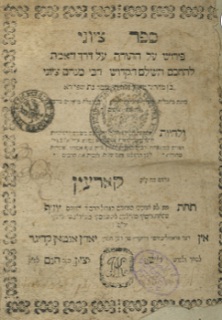
Sefer Tziyoni, Korets, 1785.

 Introduction

This article, following the theme of the previous post, further pursues the notion of demonology within Kabbalistic theology. I have drawn extensively upon the research by Professor Boaz Huss[1], a leading contemporary scholar in Kabbalah. This brief study will show just how far into the occult the mystical tradition is sometimes prepared to go.

Sunday, 7 March 2021

317) SHEMIRA: WHY PROTECT THE DEAD?


A GUEST POST BY RABBI BORUCH CLINTON:

As Rabbi Michal notes on his Kotzk Blog, many of the customs currently associated with death in Judaism were formalized only in the last few centuries. Reading that article got me thinking about some specific practises and their origins.

The first of those that came to mind was the protection (shemira) we insist in providing bodies before they reach burial. Besides the obvious fact that it’s perverse and cruel to just abandon a human body – especially that of a loved one – to its fate, is there any reason to continue watching it even once it’s safely reached, say, a hospital or funeral home morgue?

Sunday, 31 January 2021

312) WHAT DOES MODEH ANI MEAN?

Modeh Ani mentioned in Seder haYom by R. Moshe ben Machir. Published in Venice 1599.


 GUEST POST BY RABBI BORUCH CLINTON:  (See  Boruch Clinton's Finding Tradition project)


What Does Modeh Ani Mean? 

                         מודה אני לפניך מלך חי וקים שהחזרת בי נשמתי בחמלה רבה אמונתך 

Those 12 words mark the start of each day for many Jews. It's a beautiful prayer and an expression of the many debts we owe to God. But three of those words might, on reflection, represent a significant theological innovation. 

Here's the whole thing translated: 

"I acknowledge before you, the living, eternal God, that you returned to me my soul, with grace and good faith." 

The three words in question are: שהחזרת בי נשמתי  - "that you returned to me my soul." Where's the innovation in that? 

Well for God to have returned our souls first thing each morning, He would have had to have first taken them. And, while relevant but ambiguous language can be found in a few midrashim (see עיון תפילה לספר  אוצר התפילות) I'm not sure we should be so quick to assume that death and rebirth is what literally happens each night. 

Sunday, 20 December 2020

306) THE ZOHARIC EMPHASIS ON AVRAHAM AS DISSEMINATOR OF NON-JEWISH MYSTICISM:


Sefer haZohar

Moreh Nevuchim

INTRODUCTION:

Almost every single version of the various narratives about Avraham contain the well-known moral lesson that he rejected the idolatrous and occultist practices of his birth culture and pioneered a new monotheistic path.

In this article, however, based extensively on the research of Professor Oded Yisraeli[1], we will explore a very different narrative of the same story. This narrative is from the Zohar which, according to Yisraeli, puts forward the view that:

[N]ot only did Abraham not separate himself from these practices but he himself was responsible for them[!]

Before we look at what the Zohar says in greater detail, let us first turn to the mainstream view as exemplified in the writings of Maimonides (or Rambam, 1135-1204):