Menu

Showing posts with label Angels. Show all posts

Sunday, 26 February 2023

419) Priestly politics, Calendar wars and early Jewish mysticism


The Dead Sea Scrolls from around the 3rd century BCE to the 1st century CE

Introduction

The Hebrew Calendar that we use today has undergone some dramatic transformation over time. What is most interesting is it seems that control over the calendars was often directly related to control over mysticism. In this article, based extensively on the research by Professor Rachel Lior,[1] we examine some of the fascinating developments of the Hebrew Calendar. Much of this information has only come to light in relatively recent times. It must be emphasised that these are Elior's views and not everyone necessarily agrees with the position she takes. Nonetheless, her observations are of great interest.

Sunday, 30 January 2022

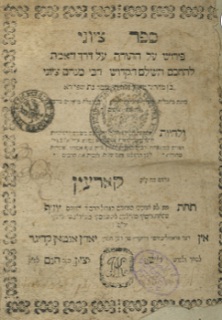
369) Menachem Tziyoni’s kabbalistic writings on demonology


Sefer Tziyoni, Korets, 1785.

 Introduction

This article, following the theme of the previous post, further pursues the notion of demonology within Kabbalistic theology. I have drawn extensively upon the research by Professor Boaz Huss[1], a leading contemporary scholar in Kabbalah. This brief study will show just how far into the occult the mystical tradition is sometimes prepared to go.

Sunday, 16 August 2020

290) WAS RASHI A MYSTIC?

Rashi's synagogue in Worms.reconstructed after Nazi desecration on Kristallnacht in 1938.

INTRODUCTION:

Rashi (1040-1105), the foremost Biblical and Talmudic commentator, is a fascinating if not an elusive personality. Much is known about him and much has been written about him, but the deeper one goes attempting to uncover the man behind the writings, the more he emerges as an enigma.

In this article, based extensively the research[1] of Rabbi Professor Ephraim Kanarfogel of Yeshiva University, we will explore whether or not Rashi would have been aware of early mystical literature and traditions.

A distinction must be made between early and late mystical traditions as the Zohar was first published around 1290 - almost two hundred years after Rashi’s passing - so the mystical literature in question could only have been the earlier Heichalot and Merkava literature.

Much of the Heichalot and Merkava literature is the collection of mystical texts from the late Talmudic (200-450) and early Gaonic (589-1038) periods. Rabbinic sages from the earlier Mishnaic period (0-200 CE) and Amoraic (Talmudic) period (200-450) are referenced in this mystical literature.

This early mysticism was anything but a mere theoretical form of KabbalahKanarfogel defines this early mystical literature as a practical and theurgic guide to the mystic who:

“...sought to enter into a sequence of Divine palaces (hekhalot) and realms by invoking specific (and often unusual) names, formulae and rituals.”

Before we delve into our question of Rashi’s involvement in early mysticism, there are two other general issues to take into consideration:

1) THE ISSUE OF THE PRINTED RASHI TEXTS:

Firstly, and perhaps most importantly, there is the issue of the accuracy of some of the printed Rashi texts we use today. The first printing of Rashi’s commentaries took place more than 350 years after his death.

Rabbi Dr Shnayer Leiman illustrates just how diverse the early printed versions of Rashi were, by comparing nine editions of the first printings of Rashi. In many instances, even on the same verse, the differences are astounding with some editions printing nothing, some waxing literal, and others saying something else entirely.


2) WAS RASHI A CORPOREALIST?

Then there is the matter of whether Rashi was a corporealist who believed that G-d had some form of a body or physicality. It is generally accepted, as Rabbi Shmuel ben Mordechai of Marseilles wrote, that most of the rabbis of northern France believed G-d comprised some form of corporealityrov chachmei tzorfat magshimim”. The question remains open as to whether Rashi was a corporealist or not.
WAS RASHI A MYSTIC?

Our interest here is the question of whether or not Rashi was a mystic.

Rashi’s timeline placed him not only two centuries before the publication of the Zohar, but also thirty years before the birth of Maimonides, the great rationalist. Thus, from the outset, we need to remember that Rashi predated the paradigms of mysticism and rationalism that we are familiar with today.

But was Rashi aware of, and did he subscribe to, the early mysticism of Heichalot and Merkavah literature?

This question is addressed and answered very differently by two scholars, Professors Joseph Dan and Ephraim Kanarfogel. Dan claims that Rashi was not aware of Heichalot and Merkavah literature while Kanarfogel believes he was.

PART I:

RASHI WAS NOT AWARE OF ANY MYSTICAL TRADITIONS:

According to Joseph Dan, Rashi was not at all familiar with Heichalot and Merkava mysticism.[2] 

Although this literature would have been known in some circles within northern France and Germany – including the later Chassidei Ashkenaz and even Rashi’s descendants and students, the Tosafists – nevertheless, according to Dan,  Rashi was not aware of this literature.

Dan brings two supports for his view:

a)  In the book of Ezekiel, where the Merkavah or Divine Chariot is described, Rashi’s commentary refuses to engage in mystical speculation. He mentions twice that we may not deal with such matters:


“We do not have permission to contemplate on this verse.”[3]


“It is forbidden to contemplate on this verse.”[4]

From these comments, it seems that Rashi either did not know (or did not want to divulge) the esoteric meaning behind Ezekiel’s mystical language.

b) Dan’s second support is from Rashi’s Talmudic commentary on Chagiga 14b, where R. Akiva and three colleagues entered the mystical state of Pardes. The Talmud records that R. Akiva issued a stark warning not to confuse the polished marble floor of the heavenly realm for water:


“When (upon your arrival in the upper worlds) you reach pure marble stones, do not say: Water, water (although they appear to be water).”[5]

The Talmud does not elaborate further on the significance of seeing water during the mystical experience.

However, in the Heichalot literature[6], the appearance of water in a vision is a sign of spiritual failure to reach the intended lofty goal of entering the ‘sixth palace’. When one sees water, the mystic’s journey is over.

But Rashi does not seem to know (or agree with) this basic Heichalot principle. According to Rashi, when the mystic sees the illusion of shimmering water, he should not think that the journey is over. As long as he does not admit defeat, he may continue with the journey.


This seems to imply that Rashi was not aware of the apparent mystical prohibition against continuing the spiritual journey as per the Heichalot texts.

Kanarfogel writes:

“On the basis of this passage, Dan maintains that Rashi was clearly unfamiliar with an essential point of Hekhalot literature, that water is an absolute sign that a mystical journey has ended.”

Hense we have Dan's view that Rashi was not familiar with Heichalot mysticism.

Not everyone agrees with Joseph Dan’s interpretation and we will now look at an opposing view that reinforces the exact opposite notion – that Rashi was well aware of Heichalot literature and that he was a mystic:

PART II:

RASHI WAS AWARE OF HEICHALOT MYSTICISM:

Kanarfogel shows, however, that there exists a variant reading[7] of the previously referenced Heichalot text (prohibiting mystical travel after visualizing the appearance of water) which is strikingly similar to the way Rashi interprets the Talmudic text above: Yes, the appearance of water does generally represent the end of a spiritual quest – but, just like the Israelites were not deterred by the waters of the Red Sea and chose to push on regardless, so too the appearance of water in a vision is an obstacle that can and must be overcome with persistence.

On this variant reading, Rashi could have been well-versed in Heichalot literature and his above mentioned Talmudic comment - that the mystic traveller should continue the journey - would be in keeping with this version of the Heichalot text.

Kanarfogel brings other examples where Rashi is similarly able to produce commentary that is in accordance with Heichalot texts:

RASHI REFERENCES MYSTICAL LITERATURE:

In another Talmudic commentary[8], Rashi makes mention of three other mystical books; Ma’aseh haMerkava, Sefer Yetzira, and Ma’aseh Bereishit:


Furthermore, in Rashi’s commentary on the book of Isaiah, he also mentions the mystical book of Midrash Agada Ma’aseh Merkava. According to Gershom Scholem, this was a version of Heihalot Rabbati.


Scholem further points out that Rashi was familiar with the mystical work known as Shiur Komah which describes G-d as having some form of body or corporeality.

These examples indicate that Rashi was aware of numerous forms of mystical literature.

We will now look at some mystical influences which may have shaped Rashi’s mystical worldview:

MYSTICAL INFLUENCES ON RASHI:

R. SHIMON HAGADOL:

Some of Rashi’s predecessors from Mainz, where he studied, were known mystical practitioners. One of these was the Kabbalist R. Shimon ben Yitzchak Abun Kalonymous haGadol (c.970-1020). According to the Tosefta[9], he was Rashi’s teacher (although the dates do not support this view). According to Rashi himself, R. Shimon haGadol was his mother’s brother.[10] Either way, R. Shimon haGadol was likely to have had some influence on Rashi.

R. Shimon haGadol maintained, in a manuscript[11], how he ascended to heaven using certain mystical techniques, and that he found the name of G-d which was used in the creation of the world. 

In another of his mystical journeys, he claimed to have received the special liturgical tunes used by the angels. 


He also practised a mystical ritual of she’elat chalom, or dream requests.

In R. Shimon haGadol’s view, prayer was not so much addressed to G-d as it was to the angels in charge of prayers who transport them to the throne of glory. Like R. Shimon haGadol, Rashi supports the idea that prayers, in Kanarfogel’s words:

 “should be directed to the angelic beings or beings who oversee it.”[12]


Surprisingly, this approach to prayer was to become quite a common mystical perception with later mystics referring to prayer being directed to the entity known as Zeir Anpin or the Lesser Countenance.


The Machzor Vitry, written by a student[13] of Rashi, describes R. Shimon haGadol as “schooled in miracles” which leaves no doubt that we are dealing with an extremely mystical personality. He is also known for his practice of mystical rituals and reciting of adjurations which indicate that he was a practitioner of Heichalot literature. R. Shimon haGadol was also active in the mystical chain of tradition that was to become the Chassidei Ashkenaz[14].

R. ELIEZER HAGADOL:

R. Shimon haGadol’s student, R. Eliezer haGadol (d. 1060) followed in his teacher’s footsteps and was evidently an associate of Rashi. According to Kanarfogel, he too was involved in “a number of white magic techniques.”  

He instituted the custom of spilling sixteen drops of wine during the Pesach Seder. This was to represent the sixteen drops of blood from what is said to be the sixteen-sided sword of G-d. He claimed it would prevent pestilence from harming the practitioner as the word dever, or pestilence, is mentioned sixteen times in the book of Jeremiah. This notion has its roots in Sefer Heichalot. The sword is called yuhach which means sixteen strikes, and is also the name of the angel whose mission is said to be the exacting of vengeance.

Both R. Shimon and R. Eliezer spoke of the Kaddish, which, from around that time became an Ashkenazic esoteric tradition, allegedly completing the name of G-d which had been diminished by the forces of Amalek.


R. YAAKOV BEN YAKAR:

Rashi’s main teacher, R. Yaakov ben Yakar, authored an esoteric commentary on Sefer Yetzirah, again pointing to the strong possibility that Rashi was influenced by such mystical teachings.

RASHI’S OWN MYSTICAL REFERENCES:

According to Kanarfogel:

“Rashi was himself familiar with a number of esoteric traditions related to Divine Names, and with magical and theurgic techniques as well.”

In his Talmudic commentary[15], Rashi connects G-d’s name of seventy-two letters to scriptural verses. This same derivation is found in the mystical classic, the Bahir[16]. This technique was later expounded upon by the father of modern Jewish mysticism, Nachmanides (1194-1270)[17] to show the Kabbalistic doctrine of permutations of the Divine names within every verse and letter of the Torah.

Rashi also writes that the Amoraim[18] were able to create calves and other beings by combing and permuting  Hebrew letters and Divine names which they got from Hilchot Yetzirah (probably Sefer Yetzirah).[19]

Rashi mentions[20] that the four who entered the Pardes, did so utilizing permutations of the Divine names. He also writes[21] that R. Yishmael ascended to the heavens by means of similar permutation techniques. And that the kefitzat haderech or supernatural shortening of the way discussed by Rava, was undertaken by such uses of the Divine name[22].

A further attestation that Rashi was mystically inclined may be the fact that he is frequently quoted by subsequent mystical works such as Sefer haMaskil,  the Zohar, and Ma’arechet ha Elokut. And later Kabbalists such as the Chida (1724-1806) wrote that Rashi was conversant and inspired by mysticism even as he wrote his various commentaries.

There are at least two segulot or magical devices that are attributed to Rashi[23].

Kanarfogel concludes:

“Thus, Rashi’s commentaries on these matters do not simply reflect talmudic or rabbinic material that he had at his disposal. Rather they indicate that Rashi was aware of esoteric materials and teachings, and perhaps even developed or extended some of these on his own.”

If Kanarfogel is correct, this would make Rashi not only a consumer of esoteric material but also a contributor to the mystical corpus.

SIFRUT DE’VEI RASHI:

In the writings that emerged from Rashi’s school, known as Sifrut deVei Rashi, such as Machzor Vitry, the Shabbat is compared to the marriage of Knesset Yisrael to G-d - a well-known idea capitalized upon by the later Kabbalists

Furthermore, Shabbat is described as a power to combat negative spiritual forces, also something later seized upon by the Zohar

Sme writings form Rashi's school suggest that magical names be written on the parchment of Mezuzot to further aid with spiritual protection.

There are also magical adjurations to prevent forgetfulness which correspond to those found in the Heichalot writings.

All these mystical ideas were vehemently challenged by the father of Jewish rationalism, Maimonides, who suggested to his son that the commentary of Ibn Ezra rather be substituted for that of Rashi[24]. Ironically, Maimonides' son became the leader of generations of Judeao-Sufi mystics in Egypt.

ANALYSIS:

By comparison to Joseph Dan’s argument that Rashi was not familiar with mystical teachings, Ephraim Kanarfogal’s argument is most convincing.

Overall it does seem that Rashi was indeed a mystic, well-versed in Heichalot and Merkava literature and probably an important link in the chain of mystical transition that was later to culminate in the publication of the Zohar.


FURTHER READING:

[A Window into pre-Zoharic Mystical Literature.]

[How Rashi and Rambam  Part Ways on the Deepest of Issues.]

[Rambam's Only Son - Another Sufi Connection?]


[1] Ephraim Kanarfogel, Rashi’s Awareness of Jewish Mystical Literature and Traditions.
[2] Joseph Dan, Rashi and the Merkava.
[3] Ezekiel 1:27.
[4] Ezekiel 8:2.
[5] b. Chagiga 14b. Translation (Seraria): The Sages taught: Four entered the orchard [pardes], i.e., dealt with the loftiest secrets of Torah, and they are as follows: Ben Azzai; and ben Zoma; Aḥer, the other, a name for Elisha ben Avuya; and Rabbi Akiva. Rabbi Akiva, the senior among them, said to them: When, upon your arrival in the upper worlds, you reach pure marble stones, do not say: Water, water, although they appear to be water, because it is stated: “He who speaks falsehood shall not be established before My eyes” (Psalms 101:7).
[6] In both Heichalot Rabbati and Heichalot Zutarti.
[7] See David Halperin, The Faces of the Chariot, Tubingen 1988, p. 210, 534.
[8] b. Chagiga 13a.
[9] Tosefta to Shabbat 54b.
[10] b. Shabbat 85b.
[11] Ms Bodl. 1960, fol. 102r.
[12] Sanhedrin 44b.
[13] R. Simcha ben Shmuel Vitry (d. 1105, the same year as Rashi’s passing).
[14] See Perush Siddur ha-Tefillah la- Roqeah, ed. Moshe Hershler, Jerusalem 1992, vol. 1, pp. 225-29.
[15] b. Sukkah 45a.
[16] Sefer ha-Bahir, ed. Daniel Abrams, Los Angeles 1994, secs, 76,79.
[17] See the Introduction to his Torah commentary.
[18] Sages from the Talmudic period, 200-450.
[19] Moshe Idel has shown, however, that these techniques do not match the extant version of Sefer Yetzirah. See Moshe Idel, Golem (Heb.), Tel Aviv 1996, pp. 66-67, 77-78.
[20] b. Chagiga 14b.
[21] b. Berachot 51a.
[22] b. Yevamot 116a.
[23] Avraham Grossman, Rashi u-Massoret Limmud ha-Torah she-Bikhtav bi-Sefarad, pp. 50-53.
[24] Isadore Twersky, "Ha-Hishpia' R. Avraham ben Ezra `al ha-Rambam?" Rabbi Abraham Ibn Ezra: Studies in the Writings of a TwelÄ™h-Century Jewish Polymath, ed. Twersky.

Sunday, 12 July 2020

284) THE BAVLI ON ‘TWO POWERS IN HEAVEN’:


Babylonian incantation bowls or 'demon traps' which often made reference to Metatron. 

                   SHEMA BEIT RESHUYOT HEN - ARE THERE ARE TWO POWERS? 


INTRODUCTION:

In early pre-Zoharic mystical writings - known as the Merkavah and Heichalot literature - the angel Metatron is featured as playing a dominant role in Heaven. Metatron is described as such an elevated angel that he is referred to as Y-H-V-H haKatan or the Lesser G-d.

This is an astounding assumption, even for an early mystical literature, as it opens the door for ‘Two Powers in Heaven’ – G-d and Metatron - which poses a serious threat to basic monotheism which subscribes to only ‘One Power in Heaven.’

What comes as even more of a surprise is that the Two Powers in Heaven concept also features in the Babylonian Talmud.

The notion of Two Powers in Heaven is, as one might expect, subject to much scholarly debate.
In this article, I have drawn from various sources including Professors Alan F. Segal[1], Daniel Boyarin[2], Peter Schafer[3] and Adiel Schremer[4].

POSITION I:

AN EXISTENTIAL CRISIS – ‘GIVING UP ON G-D’:

According to Adiel Schremer of Bar Ilan University, resorting to such an unexpected expression of belief in Two Powers in Heaven was not meant as a theological stumbling block in the way of monotheism, but rather an act of protest against G-d after the destruction of the Second Temple and sprung from a mood of despair.

Schremer writes:

“In contrast to previous interpretations I suggest that Two Powers, as constructed by early rabbinic sources, is one of a variety of theoretical options, which early rabbinic sources view as an expression of existential giving up on God, because of His inability to demonstrate His power, as was exposed in the destruction of the Second Temple and the military defeat of the Jews in the Bar Kokhba revolt. On this reading, Two Powers was not considered by the Rabbis as a threat due to a theological challenge it imposed to the monotheistic principle, as it is frequently seen...

It turns that Two Powers was not conceived of by Palestinian Rabbis as a theologoumenon characteristic of any specific group—either Christianity, as suggested by some scholars, or Gnosticism, as maintained by others. Rather it was understood as an existential response of despair, to what appeared to be God’s refraining from revealing His power.”[5]

POSITION II:

THE MAKING OF A HERESY:

Daniel Boyarin takes another approach and writes:

“[F]rom my point of view, the orthodoxy that the Rabbis [of the Talmud][6] were concerned about was an orthodoxy that they were making by constructing ‘Two Powers in Heaven’ as heresy, at just about the same time that bishops were declaring the belief in ‘One Power in Heaven’ – ‘Monarchianism’[7] – a leading heresy of Christianity.”

According to Boyarin, the rabbis were thus drawing a theological line in the sand at the time Christianity was beginning to develop its dogma.

However, as we shall see, it was not so simple to declare the belief in Two Powers in Heaven as heresy - because it persisted to linger in some of the literature.

POSITION III:

THE NOTION THAT THERE ARE ‘TWO POWERS IN HEAVEN’:

We will now explore a third and perhaps more literal reading of Two powers in Heaven, with G-d somewhat ‘sharing’ His power with Metatron:

THE DIFFERENCES BETWEEN THE BABYLONIAN TALMUD AND THE PALESTINIAN TALMUD:

The notion of Two Powers in Heaven is - by far - more dominant in the Talmud Bavli than in the Talmud Yerushalmi. This highlights the fundamental different theologies or Hashkafot within the two Talmudim.

Peter Schafer writes:

“I have repeatedly argued that certain traditions are unique to the very specific historical and cultural context of Babylonian Jewry, and my findings regarding the figure of Metatron confirm this claim.”

In other words - on this view - the Babylonian Jews were more readily prepared to entertain the notion of Two Powers in Heaven than their Palestinian counterparts.

Even without Shafer’s interpretation, this does appear to be the case by a simple reading of the relevant texts from the Bavli.

This is a fascinating position because it shows a great theological divide between the Bavli and the Yerushalmi on such a fundamental principle.

It must be pointed out that it is not only with regard to Matatron that we see such differences in worldview between both Talmudim. Babylonian culture, in general, was steeped in Angelology and Demonology. This is why Angelology and Demonology are mentioned far more frequently in the Bavli than in the Yerushalmi. Clearly, both Talmudim represented different theologies on these esoteric matters.

EARLIEST MIDRASHIC REFERENCE TO METATRON:

A) SIFRE DEVARIM:

The earliest Midrashic reference to Metatron is in Sifre Devarim which dates back to the 3rd-century:


Just before Moshe passes away, the Torah tells us that Hashem allows him a glance at the Holy Land:

 “...The Lord addressed Moses as follows: Ascend this mountain of Avarim, Mount Nevo, which is in the land of Moav, across from Jericho, and view the land of Canaan, which I am giving the Israelites for a possession.” (Devarim 32:48)

R. Eliezer says: “The finger of the Holy One...is what served Moses as metatron, pointing out to him all the cities in the Land of Israel...”[8]

B) BEREISHIT RABBAH:

Another slightly later Midrashic source is the Bereishit Rabbah:


This Midrash is based on the verse in Genesis describing the creation of dry land: “Let the waters under the sky be gathered together into one place, and let the dry land appear” (Ber. 1:9) and then that verse is related to another verse in Tehillim (104:7): “At Your rebuke they [the waters] flee; at the sound [voice] of Your thunder they take to flight.

“R. Levi said: ...The voice of the Lord became a metatron to the waters...”

In this second source, it is G-d’s voice not finger that becomes a metatron.

METATOR BECOMES METATRON:

Interestingly the name Metatron is derived from the Latin and Greek word ‘metator’ which means ‘guide’.

Schafer suggests that at this stage these two early Midrashic sources may not necessarily be referring to an angel called Metatron but rather to a power of G-d – His anthropomorphic finger or voice – which serves as a metator or guide.

It was only later, in his view, that medieval scribes replaced metator with Metatron after the well-known angel Metatron who had become popularised in the Babylonian literature.

RE’UYOT YECHEZKEL:

In a mystical work entitled Re’uyot Yechezkel or Visions of Ezekiel, there is another reference to Metatron. This work described its perception of the seven heavens and who or what inhabits which realms. In the description of the third heaven, called Zevul, R. Levi describes the Sar or Prince sitting before myriads of ministering beings. 

This is followed by a discussion of what the Prince’s name is. Suggestions follow with the names Kimos, Me’atah, Bi’zevul, Atatyah, and finally Matatron. Metatron is described as being connected to Gevurah which is reference to G-d.

Essentially, Metatron emerges from this text as being very similar and close to G-d Himself.
Re’uyot Yechezkel is associated, according to some scholars including Gershom Scholem[9] with the Merkavah literature. However other scholars disagree and Schafer considers it a later Babylonian composition written pseudoepigraphically - something very common in historical times - as if it were an earlier Palestinian mystical work.

This second view is significant to our discussion as it reinforces the hypothesis that Metatron was a Babylonian innovation and not something entertained by the Palestinian rabbis.

SOURCES FOR METATRON IN THE BABYLONIAN TALMUD:

1) ELISHA BEN AVUYAH:

According to the Talmud Bavli[10] the great heretic Elisha ben Avuyah, also known as Acher, sees Metatron sitting on a throne and he concludes that there are two Reshuyot or Powers in Heaven. Thus Metatron is more than just an angel but enjoys a higher G-d-like status. 

The narrative continues with Metatron receiving sixty fiery lashes from another divine power, Anafiel, “so that everyone will know who is the master and who is the slave”.[11] Nevertheless, Acher was led to believe that there were two powers in Heaven and he became a heretic because he was raised believing there was only one.


2) YISHMAEL BEN ELISHA:

According to another source[12], R. Yishmael ben Elisha haKohen once entered the (heavenly) Holy of Holies and he saw Akatriel Ka Hashem Tzevakot seated on an exulted throne. Akatriel[13] here is clearly not a mere angel but, like Metatron (with whom he is identified in Heichalot sources) enjoys a higher G-d-like status as can be seen by his assuming G-d’s names of Ka and Hashem Tzevakot.
Akatriel asks R. Yishmael to bless Him, which he does and the Talmud concluded that the blessing of a simple person should never be taken lightly as even Akatriel/G-d/Metatron needs to be blessed. 

This text, surprisingly, leaves room for the notion of two powers in Heaven.

In fact, the Sefaria interpretation of this text clearly states that Akatriel is:

“Akatriel...[is] one of the names of G-d expressing his ultimate authority...If God [Akatriel][14] asked for and accepted a man’s blessing, all the more so that a man must value the blessing of another man.”


RAZO SHEL SANDALFON:

In another version of this story as told in Heichalot work, Razo Shel Sandalfon, R. Yishmael is identified as Acher and he meets Akatriel similarly sitting on an exulted throne at the entrance to the inner sanctum called Pardes, giving the impression that there are two powers in Heaven. Surprisingly, G-d does not, in this version of the narrative, rebuke Acher for drawing this conclusion but simply tells him not to interfere in G-d’s mysteries!

Amazingly, this Heichalot version of the Talmudic story seems to confirm the notion that Akatriel/Metatron is one of those two powers in Heaven (although here, unlike the Bavli version, he does not seem to be equated directly with G-d).

HEICHALOT RABBATI:

Another incident relating to R. Yishmael is recorded in Heichalot Rabbati[15] where R. Nechunya ben Hakana adjures R. Yishmael with a ‘great seal’ to protect him from forgetting all the Torah he had studied. The ‘great seal’ belonged to:

 “Zebudiel the Lord, the God of Israel and this is Metatron the Lord Y-H-V-H, the God of Israel, God of heaven and God of earth, God of gods, God of the sea and God of the mainland.”

There is certainly no ambiguity in this source as to who Metatron is.

3) RAV IDIT AND THE HERETIC:

The Babylonian Talmud[16] records a discussion between Rav Idit and a min or heretic. The min points out that the biblical verse: “And to Moses He said: Come up to the Lord,”[17] should have read: “Come up to Me,” – otherwise it implies another power in Heaven.

Astoundingly Rav Idit responds that in that instance, “the Lord” refers to “Metatron, whose name is like that of his Master.

Rav Idit continues by bringing a scriptural support from another verse describing who should lead the Israelites through the desert during the Exodus:

“Behold I send an angel before you to keep you in the way and to bring you to the place that I have prepared. Take heed of him and obey his voice; do not defy him; for he will not pardon your transgression, for My name is in him.”[18]

The min responds that if so, we should worship Metatron as we worship G-d! The text continues with some to and fro with Rav Idit eventually acknowledging the existence of the ‘Guide’ (be’ farvanka) but clarifying – just on a technicality – that, during the Exodus, we did not accept the other Power (Metatron) but chose only relate to G-d Himself. 

This Guide/Metatron would have led the Jewish People to the Land of Israel but Moses told G-d that if G-d Himself does not accompany the Jewish people they do not want to travel to Eretz Yisrael.
Essentially Rav Idit was admitting that there are two powers in Heaven, and even when the ‘second power’ was offered to us in a biblical verse, we chose G-d instead!


METATRON ON BABYLONIAN INCANTATION BOWLS:

The name Metatron appears on many Babylonian incantation bowls, indicating that his name was well-known and well-used during Talmudic times in Bavel. The bowls were turned upside down and set in the foundations of the houses in order to trap demons and keep them contained therein. Many of these bowls were commissioned by Babylonian Jews between the 6th to 8th-centuries, corresponding to the period of the Babylonian Talmud.

This makes sense as Angelology and Demonology were popular in Zoroastrian Babylonia and comprised a significant component of Babylonian influence on the Babylonian Talmud.
Metatron was often referred to on the incantation bowls as Sara Rabbah or Great Prince, a title commonly used for Metatron in the Heichalot literature.

METATRON LARGELY ABSENT FROM YERUSHALMI:

By stark contrast - as mentioned earlier - Metatron and the idea of Two Powers in Heaven is almost entirely absent from the Yerushalmi and Palestinian sources.
This supports the idea that Angelology was a common feature of Babylonian Jewry but had little influence of the Jews of Eretz Yisrael.

The notion of Metaton and Two Powers in Heaven belong to Babylonian traditions and, although popular, cannot be considered universal Jewish beliefs as evidenced by them being largely ignored by Palestinian Talmudic sources.

ANALYSIS:

Surprisingly we see how, sometimes, even our primary texts flirt dangerously close to ideas that appear as anathemas to basic and pure monotheism. 

The Mishna [Ber. 33b], which preceded the Babylonian Talmud, ruled against an apparent minor matter of saying modim modim (thank You, thank You) in the prayers, as it may appear as if the worshipper was praying to two different entities. Obviously, these were issues that were prevalent within the Jewish community. Yet later, during Gemara or Talmudic times, the Babylonian culture clearly fell foul of Mishnaic rulings such as these.

Perhaps it was because of notions like Two Powers in Heaven that Maimonides, following the Yerushalmi, took a powerful stance against Angelology and Demonology in an attempt to rid Judaism of some of the cultural influences of Babylonia.

The Babylonians sought, as it were, to overpopulate the Heavens with angelic hierarchies, evil entities and even Divine ‘vice-regents’ - while Maimonides theologically ‘depopulated’ the Heavens, removed the esoteric clutter and taught of a clean, open and silent ‘space’ between man and G-d.

FURTHER READING:


[1] Alan F. Segal, Two Powers in Heaven: Early Rabbinic Reports about Christianity and Gnosticism (Leiden: Brill, 1977).
[2] Daniel Boyarin, “Two Powers in Heaven; Or, The Making of a Heresy,” in The Idea of Biblical Interpretation: Essays in Honor of James L. Kugel (ed. Hindy Najman and Judith H. Newman; Leiden: Brill, 2004).
[3] Peter Schafer, Metatron in Babylonia.
[4] Adiel Schremer, Midrash, Theology, and History: Two Powers in Heaven Revisited.
[5] Schremer elaborates in a footnote: “In suggesting that for second-century Palestinian Rabbis Two Powers was not a pure theological problem, but rather an existential reaction to concrete historical events of military defeat, I do not wish, in any way, to be understood as claiming that this is the only perspective existing in the entire rabbinic corpus of late antiquity. Change through time is the fate of most human ideas, the one to be discussed here is no exception. Therefore, the possibility that Two Powers retained a different meaning in rabbinic sources of later times should not pose any difficulty to the thesis hereby suggested, which concentrates primarily on the rabbinic sources of late first and second centuries C.E.” He also writes: “the discussion must be confined (at least in its initial stage) to the Tannaitic sources. Later, Amoraic sources will be left aside, in order to avoid the danger of anachronistic projections of notions that may be existing only in late, Amoraic, materials onto the early, Tannaitic, ones.”
[6] Parenthesis mine.
[7] Defined by the Catholic Encyclopaedia as: “A Christian theology that emphasizes God as one person, in direct contrast to Trinitarianism which defines God as three persons coexisting consubstantially as one in being.”
[8] Sifre Devarim 338.
[9] Gershom Scholem, Jewish Gnosticism, Merkabah Mysticism, and Talmudic Tradition. 5, 44-45.
[10] Chagigah 15a.
[11] Tosefta Chagiga 2:4.
[12] Berachot 7a.
[13] Or Achtriel.
[14] Parentheses mine.
[15] Heichalot Rabbati 279.
[16] Sanhedrin 38b.
[17] Shemot 24:1.
[18] Shemot 23: 20-21.