Menu

Showing posts with label Censorship. Show all posts

Sunday, 20 November 2022

406) Rashbam as Rashi’s exegetical ‘enfant terrible’?[1]


Introduction

This article, based extensively on the research by Professors Jason Kalman,[2] and Hanna Liss, deals with the commentaries of R. Shmuel ben Meir known as Rashbam (1085-1158),  Rashi’s grandson. Some of Rashbam’s commentaries on the Torah were, and to this day are still considered contentious. In a recent paper, for example, Professor Hershey Friedman writes:

“Regrettably, publishers today want to censor opinions that do not fit the mainstream way of thinking. [Ben Zion] Katz (2020, para. 1) asserts: 'Orthodox theology today is much narrower than what was acceptable in the Middle Ages.' He mentions that ArtScroll Publishing is editing and removing comments made by Rashbam that the editors believe are too radical from the new  Mikraot Gedolot.”[3]

Sunday, 9 January 2022

366) Changing perceptions of the “other”


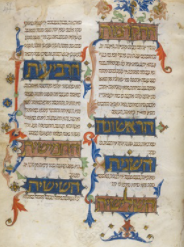
This manuscript is of the Hebrew translation from the original Arabic Guide of the Perplexed, translated by Samuel Ibn Tibbon (died c. 1230). It was produced in Spain, around 1350. 

Introduction

This article, based extensively on the research by Professor Menachem Kellner[1], examines various perspectives of the “other” in the writings of Maimonides and traces how these teachings were sometimes changed by later editors who attempted to “correct” the original Maimonidean texts. Kellner (2007:1) explains that the reason why later editors and copyists were keen to change the original Maimonidean texts was “to pull the sting of their universalism and make them accord with more widely accepted notions of Jewish separateness and superiority”.

Sunday, 13 June 2021

340) CENSORING THE TORAH COMMENTARY ASCRIBED TO R. YEHUDA HECHASID:


Image from The Temple Institute

INTRODUCTION:

In 1975 Rabbi Yitzchak Shimshon Lange published a collection of commentaries by R. Yehuda heChasid (1150-1271), a leader of Chasidei Ashkenaz, entitled Commentaries on the Torah by R. Judah he-Hasid[1].

Despite the rather innocuous-sounding title, this anthology included three commentaries that suggest that certain sections of the Torah were added after the time of Moshe Rabbeinu. A fourth commentary suggests that David removed sections of poetry from the Torah and included them in his book of Psalms. All this coming from someone like R. Yehuda heChasid naturally raised some eyebrows.

In this article, based extensively but not exclusively on the research by Professor Eran Viezel[2], we examine one of these four commentaries.

Sunday, 4 February 2018

162) HOW THE ‘MEOR EINAYIM’ WAS ALMOST BURNED OUT OF JEWISH HISTORY:

First edition of Meor Einayim, Mantua, Italy 1574.
INTRODUCTION:
Rabbi Azariah ben Moshe dei Rossi (1511-1578) was an Italian rabbi, archaeologist, historian and physician. His family, according to an old tradition, had deep roots in Italy as his ancestors were one of four noble families taken to Rome from Jerusalem at the time of Titus, after he destroyed the Second Temple in 70 AD.
He was known as Azariah min haAdumim (of the red family), which was probably a play on his surname, Rossi, which is Italian for red.[1]
After an earthquake destroyed his home, he went to live in the countryside and there he became acquainted with a certain Christian scholar. R. Azariah became particularly interested in history and even studied Christian religious records.


Earthquake in Italy 2017
The scholar asked him if there was a Hebrew translation of the Letter of Aristeas (a Second century BCE text belonging to the Apocryphal literature[2] describing the Septuagint - the translation of the Torah into Greek. The Septuagint was commissioned by the librarian of Alexandria[3], and seventy[4] Torah scholars were sent from Jerusalem to Egypt to work on an accurate translation. The Letter of Aristeas, gives details of the event.)

Latin translation of the Letter of Aristeas, 1480.

No Hebrew translation of the Letter of Aristeas existed at that time, but within twenty days, R. Azariah prepared a translation for the Christian scholar. He called the work Hadrat Zekenim or Glory of the Elders.
MEOR EINAYIM - ‘THE MOST AUDACIOUS JEWISH HISTORICAL WORK OF THE SIXTEENTH CENTURY’[5]
HIS VIEW ON TALMUDIC AGGADAH:
R. Azariah dei Rossi is best known for his controversial work Meor Einayim, or Light of the Eyes.[6] In it he openly takes to task some of the Aggadic (non-legal) sections of the Talmud and questions their historical and factual accuracy.
One such example is the Talmudic account[7] of the death of Titus at the age of forty-two, as he returned from Jerusalem to Rome, where a gnat was said to have entered his nose and then consumed his brain. The Talmud says:   “The gnat was like a one year old pigeon...Abaye said its mouth was of copper and its nails of iron.”
The questioning of Talmudic anecdotes such as these was no light matter as many regarded everything, including the non-halachik statements recorded in the Talmud as sacrosanct (even though the Talmud itself often acknowledges its frequent usage of ‘guzma’ or exaggeration, which was common during that milieu).
R. Azariah dei Rossi tied to harmonise the Talmudic teachings on natural science, mathematics and astronomy, with the sciences as they were known in his day, more than a thousand years later.
JEWISH HISTORY:
Other sections of Meor Einayim deal with issues of Jewish history, archaeology, the Septuagint, a commentary on parts of Josephus, quotes from Philo and interesting anomalies like the Queen who converted to Judaism, Heleni haMalkah.
R. Azariah dei Rossi also questioned the accuracy of the rabbinical account of history - particularly the Persian era, following Ezra and Nechemiah - and claimed that they had left out and not accounted for a period of one hundred and sixty-six years.
He upset some of his rabbinical colleagues because he was prepared to rely on non-Jewish sources for his chronicling of Jewish history. He had to do this because since Josephus (37-100 AD) there were hardly any Jewish historians. In a sense, he had reclaimed writings like Philo and parts of the Apocrypha from Christian custodianship and brought them back to Judaism.[8]
David Michael Rosenberg-Wohl writes about the lack of interest in history, prevalent in the Jewish world at that time: “It should not be underestimated just how difficult it was for Jewish scholars interested in exploring Jewish history in the greater non-Jewish culture to convince non-Jews of the importance of their task. There were no established libraries of Jewish material, no courses of study in the universities and no academic careers possible to pursue.[9]
THE JEWISH CALENDAR:
R. Azariah dei Rossi continued ruffling feathers by pointing out that the calendar used in his time which dated of the age of the world from the time of creation, was relatively recent and had not been used in either Talmudic or even Gaonic times. This view got him into a lot of trouble because effectively he was saying that the common Jewish calendar was untraditional and false. Shortly before he died, he wrote a book entitled Matzref laKesef, supporting his views about the calendar.
OPPOSITION TO MESSIANIC FERVOUR:
In one section of Meor Einayim he strongly rejects the messianic fervour that had swept across the Jews of Italy who believed the Messiah was to come in the year 1575 (which corresponded to the Jewish year 5335, ‘shalah’- or Shiloh, which also means Messiah).
HIS ATTACK ON THE RAMA:
In one very bold comment, R. Azariah dei Rossi attacked R. Moshe Isserless (the Rama 1520-1572) who is famous for his notes to the Shulchan Aruch, for his “apparent failure to embrace the truth from whatever source it might come from.”[10]


1570 edition of Torat haOlah by R. Moshe Isserless (Rama).

And according to Gotthard Deutsch, R. Azariah was a staunch critic of the Rama’s Torat haOlah, as “an unsystematic, incoherent collection of arbitrary ideas...and... it is unintelligible how the author of such a book should enjoy a reputation of a scholar.”[11]
CONTRIBUTION TO ITALIAN LITURGY:
R. Azariah dei Rossi wrote and composed many piyutim, or of liturgical poems which are included in the Shabbat and Tom Tov prayers of Italian Jews.
OPPOSITION TO R. AZARIAH DEI ROSSI:
While the Meor Einayim was still in the process of being printed, there were already murmuring against his radical work. R. Rossi got wind of some of the objections and systematically dealt with them. He had sufficient time to incorporate his responses back into his book before the publishing process was completed.
Some, like the Maharal of Prague (1520-1609)[12], took great umbrage and severely criticised R. dei Rossi, calling him a ‘mevazeh divrei Chazal’, someone who ‘disparages the words of the Sages’.
ACCUSATIONS OF HERESY:
Then there were those who did not just criticise R. Azariah dei Rossi views but went so far as to declare his Meor Einayim to be a work of outright heresy.
BURNING MEOR EINAYIM:
Among those who regarded the book as heretical was the author of the Shulchan Aruch, R. Yosef Karo (1488-1575). He ordered his student R. Elisha Gallico to enact a law requiring all copies of Meor Einayim to be burned. But R. Karo passed away before he had a chance to sign the decree, so instead of burning the books, a ban was placed on anyone under the age of twenty-five, prohibiting them from reading them.
The Christians, on the other hand, were fascinated by Meor Einayim and translated parts of it into Latin!
BANING MEOR EINAYIM:
Even while the Meor Einayim was in the process of being printed, the rabbis of Venice under R. Katzenellenbogen placed the book under a ban, unless one had obtained special permission them to read it. Interestingly enough, R. Azariah was not personally attacked as his conduct certainly met with the orthodox standards of his day.
R. Azariah dei Rossi even agreed to publish and append the critiques of his book together with his writing in an attempt to get his work unbanned – but his efforts were in vain.
He even agreed to remove a number of leaves from his printed work but that too was to no avail – to this day some editions still have more leaves than others.
The various bans against him persisted for over one hundred years with hardly anyone bold enough to even quote him during that time.
SUPPORTERS:
Later on, the Meor Einayim fell back into favour when the Vilna Gaon (1720-1797) studied it and quoted from it.
Even the Chassidic Master, Rav Tzadok haCohen (who was related to the Vilna Gaon and traced his ancestry to the Maharal of Prague – who had criticised R. Azariah!) had studied Meor Einayim, and spoke highly of it. See KOTZK BLOG 135.
R. Yaakov Emden cites the Meor Einayim and alternately praises and challenges his views.
ANALYSIS:
It is astounding to see the diverse array of reactions to the Meor Einayim: R. Yosef Karo wanted to burn the book, yet the Vilna Gaon was happy to read it.
As we have seen regarding R. Delmedigo and the Pri Chadash, R. Azariah dei Rossi joined the ranks of radical Italian rabbis who weren’t afraid to speak their minds. Perhaps it was the influence of the Italian Renaissance (14th -17th century) which accounted for this spirit of theological openness and honest intellectual investigation.
Another factor may be the apparent small number of yeshivas in Italy during this time[13]. Serious scholars were therefore forced to go to the great Italian universities in order to supplement their Torah studies. It is known that the University of Padua was one of the few universities to allow Jews to attend and even employed Jewish professors during this time. [14]
If this assertion is correct it may explain, why some of Italy’s leading rabbis were so expansive in their thinking. 
On the other hand, we do see intense opposition from other Italian rabbis – raised in the same country at the same time - to this spirit of openness.
Perhaps the answer lies in the notion that a stimulating secular intellectual environment does one of two things to a Torah scholar: it either causes certain personalities to become more insular – or it allows other personalities to thrive and create new (or rediscover old?) Hashkafic[15]precedents.


[1] Or, possibly from the fact that Rome is known in Jewish tradition as Edom (Adom - red). The Edomites descended from Esau.
[2] Or possibly the Pseudepigrapha (falsely attributed works to an author earlier in history). The Apocrypha refers to the body of literature contemporary to some Biblical texts but which were not formally accepted into the canon of the Bible.
[3] According to some accounts it was Ptolemy II.
[4] Septuaginta in Latin means seventy. Some accounts put the number at 72, which equated to six scholars from each of the twelve tribes. The work of translation was said to have taken place within 72 days.                  
[5] Yosef Hayim Yerushalmi Zakhor: Jewish History and Jewish Memory (Seattle and London: University of Washington Press, 1989), 69.
[6] Not to be confused with the more recent Meor Einayim by the student of the Baal Shem Tov, R. Menachem Nachum Twersky of Chernobyl.
[7] Gittin 56b.
[8] He wasn’t unique in this regard as Rav Saadiah Gaon also studied Apocryphal literature such as Ben Sira.
[9] Reconstructing Jewish Identity on the Foundations of Hellenistic History: Azariah de’ Rossi’s Me’or ‘Enayim in Late 16th Century Northern Italy, a dissertation by David Michael Rosenberg-Wohl, p. 14.
[10] See Historical Dictionary of Judaism, by Norman Solomon.
[11] Deutsch cites: ‘Chapter II, ed. Benjakob, p. 165, Wilna 1863.’
[12] In his Be’er haGolah.
[13] In 1467 R. Yehudah Minz established a yeshiva in the university city of Padua, Northern Italy.

[14] The Torah Ark in Renaissance Poland: A Jewish Revival of Classical Antiquityby Ilia M. Rodov, p. 88.

Regarding the famed university of Padua. It “was not only the foremost center for training Jewish physicians between the sixteenth and eighteenth century, but it aslso afforded the opportunity for socialising between Jewish and non-Jewish students. The Jewish physicians, many of them rabbis as well, were a definable social and cultural group of Jewish intellectuals that maintained close contacts among themselves and with their non-Jewish colleagues also after their return to their communities where they propagated the scientific culture assimilated during their Paduan stay.
On the other hand, from the middle of the sixteenth century, Jews went from Italy to Poland as physicians, merchants or in order to study in the flourishing Yeshivot of the country after the Talmud was prohibited in Italy.
See: Judah Moscato Sermons: Edition and Translation, Volume Four
edited by Gianfranco Miletto, Giuseppe Veltri, p. 324.

[15] Theological and philosophical Weltanschauung (worldviews).

Sunday, 28 January 2018

161) THE BAN, REPEAL, AND CENSORING OF THE PRI CHADASH:

R. Chizkiya da Silva, author of Pri Chadash.

INTRODUCTION:

The well-known commentary on the Shulchan Aruch[1], the Pri Chasdash (literallyNew Friut’) was written by Rabbi Chizkiya ben David da Silva (1659-1698).

His story is often ignored or unknown and his work is generally regarded as any other commentary. However, he was considered by some to be a very controversial figure; threatened with excommunication, flogging and even violence, and his Pri Chadash commentary was banned for some years.

Many are not aware that the version we have today is not entirely original, as parts of the Pri Chadash had to be ‘neutralized’ and ‘toned down’ before it was authorised as an official commentary on the Shulchan Aruch.

THE STORY OF R. CHIZKIYA DA SILVA:

R. Chizkiya da Silva was born in Livorna, Italy in 1659 and much happened to him during his short thirty-nine years.

At the age of thirty, he travelled to Amsterdam to try to raise money for his new book, the Pri Chadash (the first edition was published in Amsterdam, in 1692). Whilst in Amsterdam, he was offered two positions of leadership – either to remain in Amsterdam and lead the large Sephardic community, or to travel to Jerusalem and head up a new yeshiva.

Printed sermon in Ladino, by R. Chizkiya da Silva, delivered in Amsterdam, 1691.

He almost took the leadership position in Amsterdam after the community agreed to two of his demands: - firstly, that he receives a negotiated salary instead of having to rely on random ‘gifts’ from the community (which used to be the norm) - and secondly, that the community do not interfere with any of his Halachik rulings.

However, even after they agreed to those two demands, he realised that the community would never be comfortable with his radical approach to Halacha and he decided not to take the position.[2]
Instead, in 1693 he accepted the offer to head a yeshiva in Jerusalem which became known as Beit Yaakov.[3]

INSCRIPTION UNDER HIS PORTRAIT:

To see how revered R. da Silva was, one simply has to read the inscription under his official portrait[4]:


Whoever seen the Pri Chadash must say the blessing (Shehecheyanu) ‘who has given us life and kept us so that we have reached this moment’[5]...(This portrait) was stored and hidden in the archives of kings...(and) in the house of...the most learned rabbi Avraham...Lehren (who collected rabbinic portraits) in the city and mother of Israel, Amsterdam, may G-d watch over her.”[6]

R. DA SILVA AND COFFEE:

R. da Silva apparently regarded coffee very highly as a stimulant for study, because he wrote that “one cannot attain presence of mind without the aid of coffee.” This was still at a time when coffee did not taste as good as it does today and was in fact rather foul-tasting.[7] (See KOTZK BLOG 155, for a view that it may have been something stronger than coffee.)

THE CONTROVERSY:

When people started studying the Pri Chadash, they found it to be far from a benign commentary on the Shulchan Aruch:

CRITICISM OF EARLIER RABBIS:

The Pri Chadash contained criticism of earlier rabbis from the period of the Rishonim (1038-1500) and even the Gaonim (589-1038). This created much consternation in Halachik circles as the golden rule is that later rabbis do not contradict earlier rabbis because it upsets the hierarchy of the legal system.

To make matters worse, he stated that R. Dosa was mistaken in the Talmud for his zoological view regarding which animals can have horns. And R. Dosa’s view was accepted by the Shulchan Aruch![8]
This again raised the ire of the rabbinical establishment as Talmudic views are regarded as sacrosanct and can never be ‘mistaken’.
LENIENCIES:

R. Chizkiya da Silva also tended to be very lenient in his Halachik rulings - and he took to task those who pronounced strict rulings, as he felt that unnecessary stringencies drive people away.
Here is one example:

The Pri Chadash[9] states that one need not worry about keeping Chalav Yisrael in a place where it is known that milk is only produced from kosher animals, or if non-kosher milk would be more expensive. He adds that it was indeed the custom of Amsterdam not to observe Chalav Yisrael and he mentions that he kept that custom too.

הכלל העולה דבעיר שלא נמצא שם חלב טמא או שהיא יותר ביוקר מחלב טהור מותר לקנות מהעכו"ם חלב שחלבו בלא ראיית ישראל כלל וכן מצאתי המנהג פשוט פה אמסטרדם וכן נהגתי אני
Another example of his lenient views can be seen with regard to Marit Ayin (where something can become forbidden because even though one is not transgressing any law, it may appear to others as if he is transgressing):
The Pri Chadash is of the view that after Talmudic times we can no longer institute new stringencies based on Marit Ayin. This went against opinions of many others[10] including the Shulchan Aruch[11] itself, which maintained that we can and do continue to introduce new stringencies.
A ‘RAMBAMIST’ UNDERMINING THE AUTHORITY OF THE SHULCHAN ARUCH:
The challenging views expressed in the Pri Chadash often turned out to be radical rally-cries in support of Maimonides and his code, the Mishneh Torah (written in the 1200’s). So much so that he, in fact, undermined the growing authority of R. Yosef Karo’s new code, the Shulchan Aruch (written in the 1500’s), which was enjoying universal acceptance.

Most serious of all was his brazen questioning of the authority of the Shulchan Aruch as the official codification and the final arbiter of Jewish Law.

THE BAN:

When the Pri Chadash[12] reached Egypt there was a huge outcry against the work. The Egyptian rabbis proposed to excommunicate him. The excommunication, however, was not carried out against R. da Silva, and instead, it was only his book, the Pri Chadash, which was banned.

In Shut Ginat Vradim, by R. Avrahan haLevi (who was the rabbi of Egypt at that time) it is written that the rabbis of Egypt would “not let anyone read this book.” The rabbis demanded that all copies of the Pri Chadash be placed in Geniza.

SUPPORTERS:

Later, the Pri Chadash became popular and some like R. Yonatan Eybeschutz and R. Yosef Teomim (Pri Megadim) quote the Pri Chadash and follow many of his rulings.


First edition of Pri Chadash, Amsterdam 1692.

THE (CENSORED) PRI CHADASH BECOMES STANDARD COMMENTARY:

The Egyptian ban, however, was later repealed by R. Avraham haLevi - as well as by a student of R. da Silva, R. Shlomo Elgazi (who succeeded R. Avraham haLevi as the rabbi of Egypt and held that important position for forty-five years). As a result of their endorsements, the Pri Chadash became accepted by the mainstream.

In 1743 The Pri Chadash was published together with the other standard commentaries on the Shulchan Aruch. However, before it was printed it had to undergo severe ‘modification’ (or censorship). The publishers removed the harsh language of the original uncomfortable challenges to the Shulchan Aruch and then re-styled the text to conform to the other standard commentaries.

THE CONTROVERSY AS RECORDED IN GINAT VRADIM:

The following is a fascinating ‘eyewitness’ account of the controversy surrounding the Pri Chadash, as extracted from Shut (Responsa of) Ginat Vradim[13], by R. Avraham haLevi:

It so happened that a devout scholar, inflamed by the zeal of the Torah, had written a book, entitled Pri Chadash...

The book arrived in Egypt. Upon perusal of some of its content, it was discovered that the author had cast off the bridle of his tongue to say derogatory things about Israel’s great authorities, whose words we drink thirstily and whose utterances we follow.

He does not respect the rulings of the venerable elders, and refers perfidiously to our great rabbi the Beit Yosef (R. Yosef Karo, author of the Shulchan Aruch), whose work forms the basis of all our rulings and is the pillar of our study, as if he (R. Karo) were his inexperienced pupil, a fledgling who has not yet opened his eyes, in that he (R. Karo) has no qualms about forbidding what is permitted (i.e. R. da Silva accused R. Karo of being overly strict in his Shulchan Aruch.)[14].’

When this (book) was made public (in Cairo), a group of brave men braced themselves and convened the scholars of Israel who dwelled in the city (of Cairo), and also some sojourners who are here from other countries, to call the author (R. da Silva) to order.

The local scholars agreed on a course of conciliation between the two sides, to avoid physical violence to the learned author or besmirching his honour, heaven forbid, by a public flogging or excommunication.

They, therefore, admonished him privately, and he apologised and became aware of his deeds, of which he was ashamed, like a thief caught red-handed.

In order to appease the community, its leaders and officials, they agreed to bury all the books found here in Egypt in a building.[15]

And it was most solemnly decreed, and a ban was imposed...that the said book must not be read casually or deeply, by any member of the community...

It so happened that the rabbis of Hebron...happened to be here too, and they were asked to...add their signatures to the document, but they would not be bound by it, and upon leaving the city, they would hold on to the said book and study it...”

Some time past after the book was banned in Egypt. R. Da Silva had passed away and it seemed that the mood towards him had changed.

The Ginat Vradim continues:

Now several utterly wise scholars, and many others, are longing and eager to study the said book...Now the fervent about (keeping) G-d’s laws have come and asked whether or not it is possible to lift the said ban...

When I who am but junior, saw the city (of Cairo) in this commotion, and the desire of numerous scholars to find a solution...I decided to examine it as much as my frail ability permits...”
First, though, the Ginat Vradim defends the original ban:

“In my opinion, even if the aforementioned ban seems very strange (to the reader) – for how could they (the rabbis who issued the ban) agree that this book, which contains numerous novel interpretations of the law, may not be read, thereby denying academic sustenance to students? – in any event, we have found that greater precautions have been instituted, when this is required by the times, to serve as fences to safeguard the Torah.”

In other words, with the passage of time, the Law becomes more and more stringent so as to protect the institution of Halacha. (It’s interesting to note that this very notion was fundamentally opposed by R. da Silva, as we saw regarding his general aversion to extra stringencies.)

In this light...there is no doubt that the ban on the book was legally valid, for they were zealous for the honour of the early authorities. Therefore, one who makes light of and abandons this covenant is like one who transgresses the complete Torah that was given to Moses...”

Having defended the ban, Ginat Vradim continues:

Now let us see if we can find a remedy for the injury of that scholar (R. da Silva) who tarnished and ridiculed the honor of Israel’s great men.”

The main argument in favour of R. da Silva’s vindication is:

“...he has atoned for this sin by his death. Since his sin has been atoned for, the court may lift the ban...”

Then Ginat Vradim acknowledges that it was only really in Egypt that rabbis took umbrage to R. da Silva’s outspoken views:

“...the work (Pri Chadash)
 has been disseminated throughout all Jewish communities (outside of Egypt) and there have been no misgivings anywhere...”

But he continues to defend the Egyptian rabbis:

Nevertheless, the competent court of Egypt...has acted well...since the honor of the early authorities has been enhanced...”

Finally, Ginat Vradim seems to rely on ‘public discretion’ as sufficient basis to support the lifting of the ban on the Pri Chadash:

Furthermore...we see that readers of this kind of book are discriminating enough to take the insides and discard the rind, and the holy people of Israel harken to strictures and truly recognize the stature of the early authorities...”

And as the last word, going almost as far as to admit that R. da Silva may have been treated a little unfairly, he seems to end almost in desperation:

“...since there are numerous (other) books that deserve to be taken out of circulation, and no one pays them any heed (we might as well rescind the ban on the Pri Chadash). Therefore, since we know that his action did not bring about any mishap to the public, his sin may be forgiven.”[16]

ANALYSIS:

According to the Ginat Vradim, when the Egyptian ban against the Pri Chadash was rescinded, the book was to have been re-circulated in its original form. It was the ‘discriminating’ readers who would be able to choose which parts to accept and which to reject if necessary. There is no mention of the work being censored.

However, as we know, later in 1743, when the Pri Chadash became ‘standardised’ so as to conform with the other ‘normative’ commentaries on the Shulchan Aruch, the text first had to be ‘cleansed’ (apparently by the publishers).

What this amounts to, then, is that the standard published version of the Pri Chadash commentary that we use today is essentially a censored text and not entirely  the original writing of R. Chizkiya da Silva.


[1] The Shulchan Aruch was authored by R. Yosef Karo (1488-1575). The Pri Chadash commentary can be found on the sections of Orach Chaim, Yoreh Deah and Even haEzer.
[2] This is the version of the story as apparently recorded by the Chida.
[3] While in Amsterdam, R. da Silva influenced the wealthy Yaakov Pereira to fund a new yeshiva in Jerusalem under his name, hence ‘Beit Yaakov’. Interestingly, there already did exist a Beit Yaakov Yeshiva in Jerusalem, named after the Vigo brothers, which had closed in 1689. He was soon to have three prominent students, R. Shlomo Elgazi (who became the Rabbi of Rabbi of Egypt), R. Avraham Yitzchaki and R. Yitzchak haCohen (author of the Battei Kehuna).
[4] The original painting was done during the 1600’s but in the early 1800’s it was copied and the inscription was added. The new painting was part of a collection of rabbinic portraits belonging to R. Avraham Tzvi Hirsch Lehren (1784-1853). R. Lehren also ran an organization called Pekidim, which strove to ensure that there was always a strictly religious community living and studying in Israel.
[5] This was a play on the blessing oven a ‘new fruit’, or Pri Chadash.
[6] Jewish Icons: Art and Society in Modern Europe, by Richard I. Cohen.
[7] As an interesting aside, R. Yehudah Leib Nardin actually forbade coffee as a non-kosher beverage. This was, he said because sometimes meat fat was added to it. Although R. Nardin was adamant that he had seen meat fat added to coffee, it is possible that the word Cheilev (meat fat) was meant to read Chalav (milk) and that perhaps he intended to say that coffee should not be used after eating meat as it may contain milk.
[8] Pri Chadash, Yoreh Deah 80:20.
[9] Pri Chadash 115:6.
[10] Such as the Pri Toar (Yoreh Deah 87:9).
[11] Yoreh Deah 87:4.
[12] The section on Yoreh Deah to be precise.
[13] Yoreh Deah 3:3.
[14] All parenthesis are mine.
[15] My assumption is this may be a reference to the famous Cairo Geniza. See KOTZK BLOG 91.
[16] Excerpted from Controversy and Dialogue in the Jewish Tradition: A Reader, edited by Hanina Ben-Menahem, Neil S. Hecht, Shai Wosner.