Menu

Showing posts with label Babylonian influences on Talmud Bavli. Show all posts

Sunday, 2 October 2022

401) Classical Sefaradic and Ashkenazic approaches to Talmud


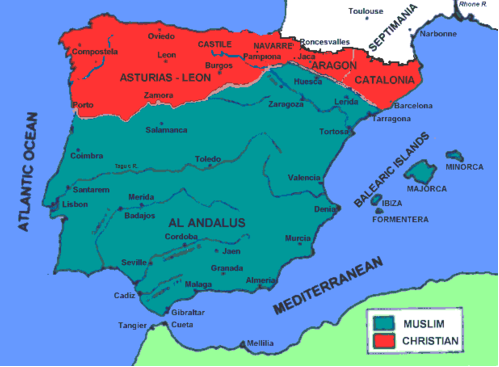
al-Andalus (Muslim Spain)

Introduction

This article is based extensively on the research by Professor Talya Fishman[1] on the differences between the classical approaches of Sefaradim and Ashkenazim to the Talmud. By ‘classical’ is meant the period prior to the thirteenth century, when there was a very distinct difference between how Sefarad (Spain) and Ashkenaz (Northern France and Germany) approached Talmud study.

Study differences between Ashkenaz and Sefarad

In Ashkenaz, the main focus of Torah study was centred primarily around Talmud study, while in North Africa and al-Andalus (Muslim-ruled Spain) they were more concerned with the study of practical Halacha as found in the locally produced eleventh-century codes of R. Nisim, R. Chananel, and R. Yitzchak Alfasi (1013–1103, ‘Alfasi’ implies ‘from Fez’, Morocco). Later in the twelfth century, the Sefaradim added the code of the Mishneh Torah by Maimonides to their study curriculum which thus continued to remain distinctly Halachic and non-Talmudic.

Sunday, 18 September 2022

400) Was it forbidden to write down the Oral Tradition?


Introduction

This article, based extensively on the work by Professor Yair Furstenberg,[1] explores the very notion of the well-known ban against writing down the Oral Tradition. It is generally accepted that rabbinic literature essentially remained in an oral form since Sinai; and that only from around the period of the redaction of the Mishna in 210 CE was it finally permitted to be written down for the first time.

However, Furstenberg writes in his Abstract that:

“multiple Talmudic anecdotes point to a complex reality that does not align with what seems as an explicit prohibition.” 

To resolve this complexity, Furstenberg suggests that we need to understand that two distinct “book cultures” existed between the rabbis of Palestine and Babylonia at that time.

Sunday, 20 March 2022

376) Babylonian influences behind the Mourner’s Kaddish

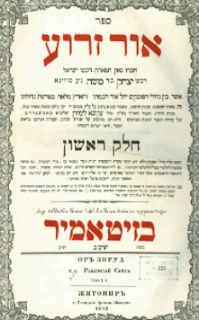
The first mention of mourners reciting Kaddish is found in the 13th century Or Zarua

Introduction

Most discussions on the origins of the Mourner’s Kaddish as we know it today, only begin from around the twelfth century in Germany. It was there that the Kaddish - which had existed from much earlier times although not necessarily relating to mourning - was finally institutionalised as mourning ritual.

This article, based on the research by Professor David Brodsky[1], traces the development of the now widespread custom of reciting Kaddish for beloved ones who have passed away, and explores where the idea originates that a child can ‘redeem’ a deceased parent.  

Sunday, 12 July 2020

284) THE BAVLI ON ‘TWO POWERS IN HEAVEN’:


Babylonian incantation bowls or 'demon traps' which often made reference to Metatron. 

                   SHEMA BEIT RESHUYOT HEN - ARE THERE ARE TWO POWERS? 


INTRODUCTION:

In early pre-Zoharic mystical writings - known as the Merkavah and Heichalot literature - the angel Metatron is featured as playing a dominant role in Heaven. Metatron is described as such an elevated angel that he is referred to as Y-H-V-H haKatan or the Lesser G-d.

This is an astounding assumption, even for an early mystical literature, as it opens the door for ‘Two Powers in Heaven’ – G-d and Metatron - which poses a serious threat to basic monotheism which subscribes to only ‘One Power in Heaven.’

What comes as even more of a surprise is that the Two Powers in Heaven concept also features in the Babylonian Talmud.

The notion of Two Powers in Heaven is, as one might expect, subject to much scholarly debate.
In this article, I have drawn from various sources including Professors Alan F. Segal[1], Daniel Boyarin[2], Peter Schafer[3] and Adiel Schremer[4].

POSITION I:

AN EXISTENTIAL CRISIS – ‘GIVING UP ON G-D’:

According to Adiel Schremer of Bar Ilan University, resorting to such an unexpected expression of belief in Two Powers in Heaven was not meant as a theological stumbling block in the way of monotheism, but rather an act of protest against G-d after the destruction of the Second Temple and sprung from a mood of despair.

Schremer writes:

“In contrast to previous interpretations I suggest that Two Powers, as constructed by early rabbinic sources, is one of a variety of theoretical options, which early rabbinic sources view as an expression of existential giving up on God, because of His inability to demonstrate His power, as was exposed in the destruction of the Second Temple and the military defeat of the Jews in the Bar Kokhba revolt. On this reading, Two Powers was not considered by the Rabbis as a threat due to a theological challenge it imposed to the monotheistic principle, as it is frequently seen...

It turns that Two Powers was not conceived of by Palestinian Rabbis as a theologoumenon characteristic of any specific group—either Christianity, as suggested by some scholars, or Gnosticism, as maintained by others. Rather it was understood as an existential response of despair, to what appeared to be God’s refraining from revealing His power.”[5]

POSITION II:

THE MAKING OF A HERESY:

Daniel Boyarin takes another approach and writes:

“[F]rom my point of view, the orthodoxy that the Rabbis [of the Talmud][6] were concerned about was an orthodoxy that they were making by constructing ‘Two Powers in Heaven’ as heresy, at just about the same time that bishops were declaring the belief in ‘One Power in Heaven’ – ‘Monarchianism’[7] – a leading heresy of Christianity.”

According to Boyarin, the rabbis were thus drawing a theological line in the sand at the time Christianity was beginning to develop its dogma.

However, as we shall see, it was not so simple to declare the belief in Two Powers in Heaven as heresy - because it persisted to linger in some of the literature.

POSITION III:

THE NOTION THAT THERE ARE ‘TWO POWERS IN HEAVEN’:

We will now explore a third and perhaps more literal reading of Two powers in Heaven, with G-d somewhat ‘sharing’ His power with Metatron:

THE DIFFERENCES BETWEEN THE BABYLONIAN TALMUD AND THE PALESTINIAN TALMUD:

The notion of Two Powers in Heaven is - by far - more dominant in the Talmud Bavli than in the Talmud Yerushalmi. This highlights the fundamental different theologies or Hashkafot within the two Talmudim.

Peter Schafer writes:

“I have repeatedly argued that certain traditions are unique to the very specific historical and cultural context of Babylonian Jewry, and my findings regarding the figure of Metatron confirm this claim.”

In other words - on this view - the Babylonian Jews were more readily prepared to entertain the notion of Two Powers in Heaven than their Palestinian counterparts.

Even without Shafer’s interpretation, this does appear to be the case by a simple reading of the relevant texts from the Bavli.

This is a fascinating position because it shows a great theological divide between the Bavli and the Yerushalmi on such a fundamental principle.

It must be pointed out that it is not only with regard to Matatron that we see such differences in worldview between both Talmudim. Babylonian culture, in general, was steeped in Angelology and Demonology. This is why Angelology and Demonology are mentioned far more frequently in the Bavli than in the Yerushalmi. Clearly, both Talmudim represented different theologies on these esoteric matters.

EARLIEST MIDRASHIC REFERENCE TO METATRON:

A) SIFRE DEVARIM:

The earliest Midrashic reference to Metatron is in Sifre Devarim which dates back to the 3rd-century:


Just before Moshe passes away, the Torah tells us that Hashem allows him a glance at the Holy Land:

 “...The Lord addressed Moses as follows: Ascend this mountain of Avarim, Mount Nevo, which is in the land of Moav, across from Jericho, and view the land of Canaan, which I am giving the Israelites for a possession.” (Devarim 32:48)

R. Eliezer says: “The finger of the Holy One...is what served Moses as metatron, pointing out to him all the cities in the Land of Israel...”[8]

B) BEREISHIT RABBAH:

Another slightly later Midrashic source is the Bereishit Rabbah:


This Midrash is based on the verse in Genesis describing the creation of dry land: “Let the waters under the sky be gathered together into one place, and let the dry land appear” (Ber. 1:9) and then that verse is related to another verse in Tehillim (104:7): “At Your rebuke they [the waters] flee; at the sound [voice] of Your thunder they take to flight.

“R. Levi said: ...The voice of the Lord became a metatron to the waters...”

In this second source, it is G-d’s voice not finger that becomes a metatron.

METATOR BECOMES METATRON:

Interestingly the name Metatron is derived from the Latin and Greek word ‘metator’ which means ‘guide’.

Schafer suggests that at this stage these two early Midrashic sources may not necessarily be referring to an angel called Metatron but rather to a power of G-d – His anthropomorphic finger or voice – which serves as a metator or guide.

It was only later, in his view, that medieval scribes replaced metator with Metatron after the well-known angel Metatron who had become popularised in the Babylonian literature.

RE’UYOT YECHEZKEL:

In a mystical work entitled Re’uyot Yechezkel or Visions of Ezekiel, there is another reference to Metatron. This work described its perception of the seven heavens and who or what inhabits which realms. In the description of the third heaven, called Zevul, R. Levi describes the Sar or Prince sitting before myriads of ministering beings. 

This is followed by a discussion of what the Prince’s name is. Suggestions follow with the names Kimos, Me’atah, Bi’zevul, Atatyah, and finally Matatron. Metatron is described as being connected to Gevurah which is reference to G-d.

Essentially, Metatron emerges from this text as being very similar and close to G-d Himself.
Re’uyot Yechezkel is associated, according to some scholars including Gershom Scholem[9] with the Merkavah literature. However other scholars disagree and Schafer considers it a later Babylonian composition written pseudoepigraphically - something very common in historical times - as if it were an earlier Palestinian mystical work.

This second view is significant to our discussion as it reinforces the hypothesis that Metatron was a Babylonian innovation and not something entertained by the Palestinian rabbis.

SOURCES FOR METATRON IN THE BABYLONIAN TALMUD:

1) ELISHA BEN AVUYAH:

According to the Talmud Bavli[10] the great heretic Elisha ben Avuyah, also known as Acher, sees Metatron sitting on a throne and he concludes that there are two Reshuyot or Powers in Heaven. Thus Metatron is more than just an angel but enjoys a higher G-d-like status. 

The narrative continues with Metatron receiving sixty fiery lashes from another divine power, Anafiel, “so that everyone will know who is the master and who is the slave”.[11] Nevertheless, Acher was led to believe that there were two powers in Heaven and he became a heretic because he was raised believing there was only one.


2) YISHMAEL BEN ELISHA:

According to another source[12], R. Yishmael ben Elisha haKohen once entered the (heavenly) Holy of Holies and he saw Akatriel Ka Hashem Tzevakot seated on an exulted throne. Akatriel[13] here is clearly not a mere angel but, like Metatron (with whom he is identified in Heichalot sources) enjoys a higher G-d-like status as can be seen by his assuming G-d’s names of Ka and Hashem Tzevakot.
Akatriel asks R. Yishmael to bless Him, which he does and the Talmud concluded that the blessing of a simple person should never be taken lightly as even Akatriel/G-d/Metatron needs to be blessed. 

This text, surprisingly, leaves room for the notion of two powers in Heaven.

In fact, the Sefaria interpretation of this text clearly states that Akatriel is:

“Akatriel...[is] one of the names of G-d expressing his ultimate authority...If God [Akatriel][14] asked for and accepted a man’s blessing, all the more so that a man must value the blessing of another man.”


RAZO SHEL SANDALFON:

In another version of this story as told in Heichalot work, Razo Shel Sandalfon, R. Yishmael is identified as Acher and he meets Akatriel similarly sitting on an exulted throne at the entrance to the inner sanctum called Pardes, giving the impression that there are two powers in Heaven. Surprisingly, G-d does not, in this version of the narrative, rebuke Acher for drawing this conclusion but simply tells him not to interfere in G-d’s mysteries!

Amazingly, this Heichalot version of the Talmudic story seems to confirm the notion that Akatriel/Metatron is one of those two powers in Heaven (although here, unlike the Bavli version, he does not seem to be equated directly with G-d).

HEICHALOT RABBATI:

Another incident relating to R. Yishmael is recorded in Heichalot Rabbati[15] where R. Nechunya ben Hakana adjures R. Yishmael with a ‘great seal’ to protect him from forgetting all the Torah he had studied. The ‘great seal’ belonged to:

 “Zebudiel the Lord, the God of Israel and this is Metatron the Lord Y-H-V-H, the God of Israel, God of heaven and God of earth, God of gods, God of the sea and God of the mainland.”

There is certainly no ambiguity in this source as to who Metatron is.

3) RAV IDIT AND THE HERETIC:

The Babylonian Talmud[16] records a discussion between Rav Idit and a min or heretic. The min points out that the biblical verse: “And to Moses He said: Come up to the Lord,”[17] should have read: “Come up to Me,” – otherwise it implies another power in Heaven.

Astoundingly Rav Idit responds that in that instance, “the Lord” refers to “Metatron, whose name is like that of his Master.

Rav Idit continues by bringing a scriptural support from another verse describing who should lead the Israelites through the desert during the Exodus:

“Behold I send an angel before you to keep you in the way and to bring you to the place that I have prepared. Take heed of him and obey his voice; do not defy him; for he will not pardon your transgression, for My name is in him.”[18]

The min responds that if so, we should worship Metatron as we worship G-d! The text continues with some to and fro with Rav Idit eventually acknowledging the existence of the ‘Guide’ (be’ farvanka) but clarifying – just on a technicality – that, during the Exodus, we did not accept the other Power (Metatron) but chose only relate to G-d Himself. 

This Guide/Metatron would have led the Jewish People to the Land of Israel but Moses told G-d that if G-d Himself does not accompany the Jewish people they do not want to travel to Eretz Yisrael.
Essentially Rav Idit was admitting that there are two powers in Heaven, and even when the ‘second power’ was offered to us in a biblical verse, we chose G-d instead!


METATRON ON BABYLONIAN INCANTATION BOWLS:

The name Metatron appears on many Babylonian incantation bowls, indicating that his name was well-known and well-used during Talmudic times in Bavel. The bowls were turned upside down and set in the foundations of the houses in order to trap demons and keep them contained therein. Many of these bowls were commissioned by Babylonian Jews between the 6th to 8th-centuries, corresponding to the period of the Babylonian Talmud.

This makes sense as Angelology and Demonology were popular in Zoroastrian Babylonia and comprised a significant component of Babylonian influence on the Babylonian Talmud.
Metatron was often referred to on the incantation bowls as Sara Rabbah or Great Prince, a title commonly used for Metatron in the Heichalot literature.

METATRON LARGELY ABSENT FROM YERUSHALMI:

By stark contrast - as mentioned earlier - Metatron and the idea of Two Powers in Heaven is almost entirely absent from the Yerushalmi and Palestinian sources.
This supports the idea that Angelology was a common feature of Babylonian Jewry but had little influence of the Jews of Eretz Yisrael.

The notion of Metaton and Two Powers in Heaven belong to Babylonian traditions and, although popular, cannot be considered universal Jewish beliefs as evidenced by them being largely ignored by Palestinian Talmudic sources.

ANALYSIS:

Surprisingly we see how, sometimes, even our primary texts flirt dangerously close to ideas that appear as anathemas to basic and pure monotheism. 

The Mishna [Ber. 33b], which preceded the Babylonian Talmud, ruled against an apparent minor matter of saying modim modim (thank You, thank You) in the prayers, as it may appear as if the worshipper was praying to two different entities. Obviously, these were issues that were prevalent within the Jewish community. Yet later, during Gemara or Talmudic times, the Babylonian culture clearly fell foul of Mishnaic rulings such as these.

Perhaps it was because of notions like Two Powers in Heaven that Maimonides, following the Yerushalmi, took a powerful stance against Angelology and Demonology in an attempt to rid Judaism of some of the cultural influences of Babylonia.

The Babylonians sought, as it were, to overpopulate the Heavens with angelic hierarchies, evil entities and even Divine ‘vice-regents’ - while Maimonides theologically ‘depopulated’ the Heavens, removed the esoteric clutter and taught of a clean, open and silent ‘space’ between man and G-d.

FURTHER READING:


[1] Alan F. Segal, Two Powers in Heaven: Early Rabbinic Reports about Christianity and Gnosticism (Leiden: Brill, 1977).
[2] Daniel Boyarin, “Two Powers in Heaven; Or, The Making of a Heresy,” in The Idea of Biblical Interpretation: Essays in Honor of James L. Kugel (ed. Hindy Najman and Judith H. Newman; Leiden: Brill, 2004).
[3] Peter Schafer, Metatron in Babylonia.
[4] Adiel Schremer, Midrash, Theology, and History: Two Powers in Heaven Revisited.
[5] Schremer elaborates in a footnote: “In suggesting that for second-century Palestinian Rabbis Two Powers was not a pure theological problem, but rather an existential reaction to concrete historical events of military defeat, I do not wish, in any way, to be understood as claiming that this is the only perspective existing in the entire rabbinic corpus of late antiquity. Change through time is the fate of most human ideas, the one to be discussed here is no exception. Therefore, the possibility that Two Powers retained a different meaning in rabbinic sources of later times should not pose any difficulty to the thesis hereby suggested, which concentrates primarily on the rabbinic sources of late first and second centuries C.E.” He also writes: “the discussion must be confined (at least in its initial stage) to the Tannaitic sources. Later, Amoraic sources will be left aside, in order to avoid the danger of anachronistic projections of notions that may be existing only in late, Amoraic, materials onto the early, Tannaitic, ones.”
[6] Parenthesis mine.
[7] Defined by the Catholic Encyclopaedia as: “A Christian theology that emphasizes God as one person, in direct contrast to Trinitarianism which defines God as three persons coexisting consubstantially as one in being.”
[8] Sifre Devarim 338.
[9] Gershom Scholem, Jewish Gnosticism, Merkabah Mysticism, and Talmudic Tradition. 5, 44-45.
[10] Chagigah 15a.
[11] Tosefta Chagiga 2:4.
[12] Berachot 7a.
[13] Or Achtriel.
[14] Parentheses mine.
[15] Heichalot Rabbati 279.
[16] Sanhedrin 38b.
[17] Shemot 24:1.
[18] Shemot 23: 20-21.

Sunday, 7 June 2020

279) A BABYLONIAN CONTEXT TO THE BABYLONIAN TALMUD:

Rabbi Professor Yaakov Elman (1943-2018) who specialised in Talmudo-Iranica.

Babylonian Influences on the Talmud Bavli. Part V.

INTRODUCTION:

Rabbi Professor Yaakov Elman (1943-2018) of Yeshiva University was a pioneer in the research of Babylonian (i.e., Iranian/Sasanian/Persian/Zoroastrian)[1] influence on, and context to the Babylonian Talmud.

In this article (part 5 in the series) we will continue to look at some of this Babylonian context and culture which is critical for an understanding of the milieu in which the Babylonian Talmud was developed. I have drawn from the research of Rabbi Yaakov Elman’s student, Professor Shai Secunda, a graduate of Yeshiva Ner Yisrael in Baltimore and now a highly respected academic.[2]

THE CONTEXT BEHIND THE TEXT:

Secunda writes about his teacher Rabbi Elman:

“[S]ince the turn of the century Yaakov Elman has been instrumental in establishing an important subfield of Jewish studies that has come to be known as Talmudo-Iranica. Elman has produced cutting-edge research that hones in on the Talmud’s Iranian context, and he has encouraged Talmudists to study Iranian languages (mainly Middle Persian) and forge contacts with Iranists so that they might read the Babylonian Talmud contextually...”

This understanding of general Babylonian culture and language is important because:

“...when it comes to research on rabbinic law and its interaction with Zoroastrian ritual...laws are studied against specific Zoroastrian parallels in order to account for their development.”

HOW THE ZOROASTRIANS READ THEIR TEXTS:

Bear in mind that Zoroastrianism, the religion of the Babylonians, is considered to be a very ancient form of monotheism with many beliefs compatible with Judaism. Babylonian Jews were more comfortable with the neighbouring religion of Zoroastrianism than with Paganism, Christianity and later Islam. 

In Sasanian Iran, however, scriptures were not the Bible or Tanach but instead the Avesta.

Around the year 200 CE, with the emergence of the Babylonian Talmud, Zoroastrian hermeneutics or scriptural interpretation had already been ongoing for some centuries by elite Babylonian scholars.

Many would not expect to find detailed parallels and similar styles in Avestan hermeneutic (i.e., interpretive[3]) literature and learning methodologies to that of the Babylonian Talmud. Yet, as we shall see, many ideas and even institutionalized methodologies of study and belief often overlapped rather overtly.

We know that Halachic concepts were first part of an oral tradition before they became crystallized in written form during (or after – see  When was the Talmud Written Down? ) Talmudic times.

Secunda explains that the Avesta also started out as an oral tradition:

“The Avesta was transmitted orally from the moment of its inception in two basic modes: the first, prior to crystallization, consisted of a series of ‘recomposed performances’ by avestan poets, and the second, following crystallization, employed a rigid technology of memorization and transmission.”

These two Avestan transmission processes took place through the medium of two different languages, Old Avestan and Young Avestan.

In Judaism the oral transmission took place through the use of Hebrew (up to and including Mishnaic times, 0-200 CE) and then transitioned to Aramaic, the language spoken in Babylonia (during Gemara or Talmudic times, 200-500 CE). Often, in the Talmud, a phrase from the older Hebrew Mishnaic version is used as a starting point for lengthy Halachic discussion and inquiry.

In Avestan hermeneutics we see a similar process where an Old Avestan text is used as a basis for interpretation, re-interpretation and elucidation in Young Avestan texts.

THE VIDEVDAD:

The Avesta had sections dealing with ritual purity called the Videvdad.  This is paralleled in the Talmud with sections also dealing with purity.

R. Elman reminds us of the Babylonian Talmud’s teaching that according to R. Zeira, the:

daughters of Israel had undertaken to be so strict with themselves as to wait for seven [clean] days...[although biblically they are required only to separate for seven days from the onset of menstruation].”[4]

Also:
It is clear from Niddah (fol. 66a) that this stringency was a popular practice and not a rabbinic prohibition, probably in response to a ‘holier than thou’ attitude perceived by the populace as emanating from their Persian neighbors. It seems that Babylonian Jewish women had internalized their Zoroastrian neighbors’ critique of Rabbinic Judaism’s relatively ‘easy-going’ ways in this regard...” [5]

According to this, stringencies in the Jewish laws of menstrual impurity resulted in longer periods of abstinence, and it was all based on not wishing to appear as being ‘less holy’ than their Babylonian counterparts:

This indicates just how much the values of the surrounding culture had been internalised into the Jewish value system.”[6]

TEXTUAL EXPANSIONS:

Additionally, Young Avestan texts also introduced a form of interpretative textual expansion similar to what was known to Judaism as Midrash. In this style of hermeneutics, the basic text was often elaborated and expounded upon beyond recognition.

THE HERBEDESTAN:

A Young Avestan work known as the Herbedestan deals with religious learning and discusses matters such as what type of teacher one should pursue, how far one should travel to find such a teacher, and what type of student a teacher may accept.

This work emphasises the importance of memorizing the liturgical texts and teaches that it is a sin to not study when one is able to; and so is forgetting the literature which one has studied. These ideas and values are paralleled in Talmudic literature as well.

THE TANNA AND THE MAGUS[7] TEACH BUT DO NOT KNOW WHAT THEY ARE SAYING:

There is a fascinating Talmudic text which compares the Tanna (a term which in this case refers to Amoraic reciters of  Mishaniac material) to Zoroastrian magi (priests and scholars):

“[Just as Magi] murmur their teachings yet do not understand them – so too the Tanna teaches (the Mishna) but does not know what he is saying.[8]


This implies that that in both literatures some teachers were so concerned with the transmission of the texts that they simply repeated them without necessarily understanding them.

SERVING THE SAGES:

The students of the Zoroastrian scholars would follow their teachers around continually and serve and observe them.

There is a parallel Talmudic text which states:

“Who is a conniving wicked person (rasha arum)?... Ulla says: Someone who read (the Torah) and learned (the Mishna) but did not serve Torah scholars.“[9]


COMMENTARY STRUCTURE:

The Avesta came with the Zand which was a commentary and explanation of the primary Avestan text. The Zand served three purposes: a) to act as a translation of the Old Avesta into the Young Avesta (or Middle Persian) language,  b) to serve as a commentary, and c) to include legal derivations from the text.

The Zand would identify difficulties in the Avesta and then as Secunda says:

“...cite debates between authorities about related matters in collections of teachings”

This is again very similar in style to the debates in the Babylonian Talmud. Hence, the Zand - also composed during Sasanian times - corresponds to the methodology of Talmudic literature of the same time period.

MOVING THEIR HEADS RYTHMICALLY:

A Zoroastrian text speaks about students who would move their heads rhythmically back and forth while studying these texts and commentaries. This practice, as we know, is also well-entrenched within Judaism.

MAGI AND RABBIS DEBATING WITH HERETICS:

Sasanian Iran had some intense battles over the correct interpretation of the Avesta. This threatened the existing power structures and divided the Babylonian public into orthodox believers and heretics. Certain factions were creating new interpretations (i.e., new Zands) of the Avesta.

In some cases these new commentaries or Zands were so controversial that the magi[10] or Zoroastrian priests were requested to keep the Zands away from the public.

WHO OWNS THE PSHAT?

The interpretive battles often rose over the ‘exact’, ‘simple’ or ‘plain’ meaning of the primary source. The various sides of believers and heretics each claimed to know with definity the true meaning and intent of the original source.  Opposing camps emerged with the ‘orthodox’ Zoroastrians on the one side and ‘renegade exegetes’ on the other.

Amazingly, the Babylonian Talmud records a similar struggle and there is some considerable literature involving rabbinic sages debating with Jewish heretics or minim over Biblical interpretation and its correct pshat or exact meaning.

OMNISIGNIFICANCE:

Secunda draws our attention to the fascinating idea that it was primarily Zoroastrian magi and Jewish rabbis who believed in the ‘omnisignificance’[11] of their primary texts.

Omnisignificance means that everything is contained and alluded to within the wording of the primary text, whether the Torah or, in the case of Zoroastrians, the Avesta. This allows for multiple authoritative interpretations of the original wording because the entire universe is said to be contained within them. The text is not just words but becomes infinitely dense with meaning and significance. Words are no longer a part of writing style and certainly aren’t used by chance.

This omnisignificance allows for legal interpretative positions to be taken based on deductions from the minutia of words and letters.

Secunda writes:

“Other interpretative communities [besides those of the rabbis and Zoroastrians] employed various hermeneutical tools when interpreting texts that they perceived as sacred and thus semiotically [defined as the interpretation of words] [12] dense. Yet most of these did not go the way of halakhic midrash and the Zand.”

Thus the rabbis and magi were unique in their use of the principle of omnisignificance when it came to their primary sacred texts.

THE REACH OF OMNISIGNIFICANCE:

Rabbi Yaakov Elman (the pioneer of Babylonian studies with the intent to understand the context of the Babylonian Talmud) wrote that the term ‘omnisignificance’ is essentially only a marker for an exegetical programme that remained a goal but was never actually realized.

If I understand Elman correctly, he is saying that the notion of omnisignificance remains essentially an idea that lends great importance to the meaning of words in primary texts, but is impossible to actually implement practically.  Consider, for example, sections of primary Torah text where entire paragraphs describing journeys or events are often repeated at great length – yet the commentaries are silent on the omnisignificance of these repeated sections. 

They may explain why, in principle, it was necessary for the text to repeat itself - but remain silent on the exact details of every nuance of every detail of every repetition. In other words, one word, sentence or paragraph can be exploited interpretatively but it is difficult to do so the second time to a similar extent in the verbatim replication. This can be seen by just paging through a Chumash.  Wherever there is a repetition, sometimes even pages long, the commentary section is very much reduced.

THE CAVEAT:        

This general notion of omnisignificance, however, brings with it an important historical caveat or proviso.

Secunda explains that based on a study of earlier rabbinic sources:

“[O]mnisignificant legal exegesis is very much present in Palestinian [not Babylonian!][13] rabbinic texts prior to the intense encounter between Jews and Zorosatrians that took place in Mesopotamia.”

In other words, this concept of omnisignificance already existed amongst the earlier rabbis of Eretz Yisrael before they went into exile in Babylonia. Thus one cannot say that magi or the Babylonian interpretative culture influenced rabbinic culture when it came to ascribing omnisignificance to Jewish sacred texts.

This is a fascinating point because it shows that the reality on the ground in Babylonia during Talmudic times was one of give and take. Both Jewish and Zoroastrian intellectual communities had an influence on each other and at times borrowed certain cultural authorities from each other.  Although it is possible that both cultures simply and naturally subscribed to the atypical idea of omnisignificance (and that it is nothing more than coincidence) it seems more likely that this is an example of rabbinic influence on Zoroastrianism. 

This is especially so because the belief in the omnisignificant value of the Avesta only came to Babylonian society during the late Sasanian period, which corresponds directly to the Talmudic period. The rabbis, however, were discussing omnisignificance centuries earlier.

Interestingly, Yaakov Elman points out that Rava (or Abba ben Yosef bar Chama, 280-352 CE) a key figure at the confluence of Babylonian and rabbinic cultures, was particularly concerned about ‘managing’[14] this growing trend of placing too much weight on the principle of omnisignificance.

Secunda concludes:

“What this means in the current discussion is that the fact that omnisignificant modes of reading were an important aspect of Sasanian reading strategies is significant for appreciating their resonance in the Bavli.”

In other words, Secunda (if I understand him correctly) is saying that yes, the Palestinian rabbis were the first to discuss omnisignificance and may have influenced the Babylonians in this regard. But once it became a popular Babylonian concept it became even more popular within Judaism, to the extent that Rava had to ‘manage’ the overuse of this concept.

Either way, the mutual influence and re-influence of hermeneutical enterprises between Babylonian magi and Talmudic rabbis remains a fascinating avenue for further exploration.

After all, the Bavli is called the Babylonian Talmud.


ANALYSIS:

The academic and even religious culture of Babylonia played no small part in the shaping and development of the Babylonian Talmud. The two literary cultures were strongly intermeshed to the extent that sometimes we are not sure just who was influencing who. It is possible that rabbis contributed and introduced the notion of omnisignificance to the Sasanian worldview. And, in turn, the vibrant hierarchies of demonology and angelology were certainly a strong Babylonian influence on the Bavli.

The Talmud Bavli has indeed become the very symbol of religious Judaism.  We have even developed a proudly yet known to be incorrect style of reading Talmudic Aramaic, which is called ‘yeshivishe shprach’ or yeshiva language.

Yet there have always been those like Rambam who considered studying the Babylonian Talmud - which has become a staple of the Torah world - to be unnecessary in the aftermath of his Mishna Torah (the Halachic summary of the Bavli which excludes much of the cultural Babylonian content).

Other rabbis emphasised the study of the Yerushalmi, or Jerusalem Talmud over the Bavli, and this has gained traction within some factions in modern Israel today.

Some rabbis like Rav Kook even developed quite outspoken opposition positions to the central role the Babylonian Talmud played within Judaism. Some of these views can be seen in Rav Kook on: What if I Don’t Like Studying Gemara?

But - at the end of the day - the mainstream view is very much centred around and defined almost exclusively by the Babylonian Talmud.

FURTHER READING:


[1] Iran (Babylonia) was under Sasanian rule around the time of the development of the Babylonian Talmud. The Sasanian Empire was the last Persian dynasty to rule before the arrival of Islam. The main religion was Zoroastrianism. Hence, the terms Babylonian /Iranian/ Persian/ Sasanian/Mesopotamian and Zoroastrian will be used interchangeably in this article.
[2] Shai Secunda, Rabbinic and Zoroastrian Hermeneutics; Background and Prospects.
[3] Hermeneutics is defined as the interpretive literature and commentary based on a primary scriptural text.
[4]  Berachot 31a, Megilla 28b and Nidda 66a.
[5] See: Young Rabbis and all about Olives by Professor Marc B. Shapiro of The Seforim Blog, where he quotes R. Elman as sourced from Encyclopedia Iranica (RABBINIC LITERATURE and MIDDLE PERSIAN TEXTS).
[7] Magus (Zoroastrian priest) is singular for magi.
[8] Sotah 22a.
[9] Sotah 21b and 22a.
[10] Magi (Zoroastrian priests) is the plural form of magus (one priest).
[11] A term coined by James Kugel.
[12] Parentheses mine.
[13] Parenthesis mine.
[14] Rava debated Abaye on many Halachic issues and the law follows Rava over Abaye in all but six cases. One of the reasons why Rava’s opinion is usually adhered to is because he was more practical that Abaye, his more theoretical opponent.