Menu

Showing posts with label Abulafia. Show all posts

Sunday, 4 May 2025

509) When authority becomes the determinant of reason, meaning and truth

An early manuscript of Meirat Einayim by the 14th century R. Yitzchak of Acre
Introduction

This articlebased extensively on the research by Professor Eitan Fishbane[1]—examines the rabbinic notion of the authenticity of a teaching or text being reliant on the perceived authority of its transmitter or originator. In other words, the greater the rabbi the more authentic the teaching, regardless of the intrinsic value, nature and validity of the actual teaching itself. 

As a test case, we analyse the writings of a fourteenth-century Kabbalist, R. Yitzchak ben Shmuel of Acre in his Meirat Einayim which is a supercommentary (i.e., a commentary on a commentary) on Nachmanides’ Commentary on the Torah. Interestingly, R. Yitzchak of Acre—who lived at the same time as R. Moshe de Leon who had claimed to have discovered the ancient Zohar—questioned the attribution of the Zohar to the second-century Tanna, Rabbi Shimon bar Yochai, who lived a thousand years earlier.[2] 

Sunday, 27 February 2022

373) Kabbalah – a product of the East or West?


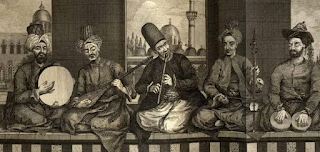
Jews and Sufis shared music traditions

Introduction

Kabbalah, until just a few decades ago, was generally understood in as originating within a Eurocentric context. It was believed to have emerged essentially from centres like Italy, Provence (southern France), Germany and Spain. In scholarly circles, this was the result particularly of the work by Gershom Scholem,[1] who was convinced of Gnostic origins to Kabbalah: He writes that it is:

surprising that the [Kabbalistic][2] doctrine…was deeply related to Gnosticism, but such are the dialectics of history” (Scholem 1941:286).

Sunday, 29 July 2018

187) THE CENSORSHIP OF ABULAFIA AND HIS ATTEMPT TO CONVERT THE POPE:


INTRODUCTION:

Avraham ben Shmuel Abulafia (1240-1291) was born in Zaragosa, Spain, in the Hebrew year 5000. He is regarded as one of the ‘neglected mystics’, known alternately as a ‘prophetic’, ‘linguistic’ and ‘ecstatic’ Kabbalist[1]

He was a fascinating and enigmatic personality because not only did he try to convert the Pope to Judaism, but he also claimed to have been the Messiah.

HIS PHYSICAL AND SPIRITUAL JOURNEYS:

R. Avraham Abulafia’s teacher was his own father, R. Shmuel, who ensured that his son was well educated in Talmud.

From the age of eighteen, when his father died, he began to travel, seemingly aimlessly, and he arrived in Acco, Israel, in search of the famous river known as Sambation. According to tradition, this river flowed so strongly during the week that it was impossible to cross, and then ceased to flow on Shabbat, when it was forbidden to cross.  Additionally, he tried to search for some of the Ten Lost Tribes of Israel, who had according to legend, crossed over that river - and rumours abounded that, at that time, they had begun to return to Israel.

He also wanted to visit Biblical places and ‘re-experience’ some of the ancient events.

However, upon arrival in the Land of Israel, he found it in turmoil as a result of the Crusades and was forced to return to Europe.

He found himself in Capua, southern Italy, where he began a relentless study of Rambam’s Guide for the Perplexed, under R. Hillel of Verona. He later taught the Guide to students in Greece.

Mainstream Kabbalah was not deep enough for him and when he returned to Spain, he began experiencing ‘visions’ while studying under Baruch Togarmi who specialised in Tzeruf, or letter combinations involving linguistic manipulations and permutations known as Gematria, Notrikon and Temurah

He additionally studied Ramban’s (Nachmanides’) mystical teachings, which, at that time was only studied in small secret groups.

INFLUENCE FROM CHASSIDEI ASHKENAZ:

Abulafia drew also from some of the earlier mysticism of Chassidei Ashkenaz, which was founded by R. Yehuda HeChassid and flourished in Germany and France during the 12th and 13th centuries. That movement was influenced by some of the earlier Merkava techniques and included some local Germanic superstitions.[2] 

During this time the famous Raziel haMalach was most likely written by R. Elazar of Worms (although some parts of the book are much older) who also gave ‘instruction’ on how to create a Golem.

At one stage, Abulafia claimed that he felt the messianic ‘anointing oil’ being poured over him and: “When I reached to the Names and untied the seal bands, the Lord of all revealed Himself to me and made known to me His Secret, and informed me concerning the end of the exile and the beginning of the Redemption.”
Abulafia began attracting a number of students, most notably Moshe Gikatilla (whom Rambam called ‘one of the most intelligent of the commentators’, see here.) Interestingly though, for some reason (which may become apparent later) Gikatilla does not mention Abulafia in any of his writings.
THE SYNTHESIS:
According to Professor Moshe Idel, Abulafia started his scholarly career with a strong influence from the rationalist Rambam, who had died just thirty-six years earlier. He then moved on to the mysticism of Kabbalah. Abulafia then, at the age of 31 created a surprising synthesis between Rambam’s rational philosophy and the mysticism of Kabbalah, particularly that of R. Elazar of Worms which is somewhat magical and places emphasis on linguistics, letters and the power of language.
This he did because he believed he was a Prophet and he also believed that he was the Messiah.[3] Thus he developed a powerful synthesis between two dominant forms of Jewish culture which had flourished during the generation preceding him.
(Ironically, there is some speculation that Rambam may have been inadvertently responsible for the popularity of mysticism during the 1200’s, which arose as a protest against his extreme rationalism.)
ABULAFIA’S GUIDING PRINCIPLES:
In creating this unusual synthesis between Chassidei Ashkenaz and Rambam, Abulafia developed a rather unique model of Kabbalah:
The Chassidei Ashkenaz - although mystical - were relatively conservative, while Abulafia was far more explorative and innovative.
Rambam, on the other hand, particularly in his philosophical writings, was quite open to allow for some allegorical interpretations of various aspects of the Torah narrative. (For example, he wrote that the sacrifices were granted to the early Israelites as a ‘concession’ for having come out of an idolatrous culture where sacrifices were the spiritual norm – but it was not to be the preferred Torah model. See here).
Abulafia then ‘borrowed’ this license to use allegorical interpretation but in a very different way to Rambam. He completely broke down and reconstructed the letters of the biblical text until they no longer related to the plain meaning and then rebuilt them in a different manner entirely to create a new ‘text’ – which he then used as a basis for the mystical interpretation and experience. By deconstructing the letters of the Torah to such an extent that they were no longer cohesive, he showed the mystical practitioner how to deconstruct his own inherent worldview and then to reconstruct a new spiritual worldview.[4]
Perhaps one could say, therefore, that Abulafia took and expanded upon the mysticism of Chassidei Ashkenaz while neglecting their conservatism – and at the same time he took precedent from Rambam for radical allegorical and ‘deconstructive’ interpretation of the Torah text, while neglecting his rationalism.
MANUSCRIPTS ONLY PUBLISHED IN THE 1990’S:
According to Professor Joseph Dan, most of Abulafia’s teachings remained available only in manuscript form and were not published until the 1990’s and even later. This means that until relatively recently not much of his approach was widely known to those who did not have access to his manuscripts. [5]
Many Kabbalistic manuscripts are housed in the Vatican Library and interestingly, Professor Idel was granted easy access to them. He even thanks them by writing:
I take this opportunity to thank the Vatican Library, late as these thanks may be, for the generosity that contributed not only to my modest studies of the Kabbalistic material, but also of many other scholars, who also benefited from the liberal approach of the directors of that Library.”[6]
SEFIROT:
Abulafia used combinations of letters, pronunciations, head and hand movements, concentration and breathing exercises. Abulafia was particularly interested in the Hebrew language although he did use Italian, Latin, Greek, Tatar, Arabic and Basque in order to ascertain Gematrias, or numerical values.
According to some[7], the authorship of the Zohar is even attributed to Abulafia (as Abulafia was the same age as Moshe de León. See here.)
While his Kabbalistic colleagues were exploring the Ten Sefirot, or Spheres, Abulafia felt this approach was worse than Christianity with their emphasis on the Trinity.
We see that Abulafia opposed and even ridiculed the Kabbalistic system of the Sefirot and substituted it with a system based on letters of the Hebrew alphabet. It is also possible that he was influenced by the Sufis.[8] (For more on Sufi influence, see Chovot haLevavot and Avraham ben haRambam.)
R. Ariel Bar Tzadok points out that the Spanish and Zoharic Ten Sefirot system, which we are familiar with today, is completely different from the earlier System of Sefirot as described originally in Sefer Yetzirah. In the earlier model, there was no concept of the Tree of Life where the Sefirot are divided into a middle, a left and a right side, and they did not have names like Chachma Bina etc.
THE POPE:
In 1280, just before Rosh haShana, Abulafia arrived in Rome in an attempt to convert Pope Nicholas III to Judaism. This was based on a spiritual experience he was said to have had, and the Pope’s conversion would have been a prerequisite for the imminent messianic age he envisioned.
The Pope, however, happened to be in his summer palace in Soriano at that time, which was not far from Rome, and Abulafia followed him there. But when he heard of Abulafia’s arrival, the Pope issued an order to have the ‘fanatic’ burned at the stake. On arrival in Soriano, Abulafia walked boldly past the pyre which had been set up for him, and then discovered that the Pope had suddenly died the previous night, August 22 1280, from a stroke!
Here is an interesting Zohar:
“And on the sixth day [Friday] on the twenty-fifth day of the sixth month [Elul - i.e.: just before Rosh haShana]... three high walls of the city of Rome will fall, and the great palace there will collapse and the ruler of that city will die.” [9]
In his Sefer haOt, Abulafia wrote: “His [G-d’s] adversary died, unrepentant, in Rome by the power of the Name of...G-d...His Name fashioned my tongue into a spear with which I killed them that deny Him, and I killed His enemies by a righteous judgement.”
Abulafia was thrown into jail by the Franciscans as they suspected he had something to do with the Pope’s death. He was held for 28 days and then released.
Pope Nicolas III was a friend of St Francis of Assisi who was the founder of the Franciscan order.
It is also possible that Abulafia was interested in meeting the Pope as he was aware that in Franciscan circles, meditation on the names of Jesus was becoming a popular technique at that time. [10]
After the incident with the Pope, he made his way to Sicily proclaiming himself as not just a Prophet but as the Messiah as well.
RASHBA EXCOMMUNICATES ABULAFIA:
When word reached R. Shlomo ben Aderet - known as Rashba (1235-1310) - about some of Abulafia’s messianic enterprises, he immediately excommunicated Abulafia.  Rashba happened to be a (Spanish) Kabbalist himself but Abulafia was considered far too radical for the mainstream Kabbalists.
Nevertheless, many of Abulafia’s works were translated into Latin by Giovanni Pico della Mirandola and were taught during the Italian Renaissance.
R. CHAIM VITAL GETS CENSORED FOR QUOTING ABULAFIA:
Four centuries later, one of the Ari Zal’s foremost students, R. Chaim Vital (1543-1620) quoted Abulafia in his Sha’arei Kedusha. The work was composed in four parts. Part Four included meditative techniques from Abulafia. Interestingly, this Part Four remained unpublished for four hundred years and was published for the first time in the 1990’s!
CHIDA ENDORSES ABULAFIA:
Five centuries later, the Chida (R. Chaim Yosef David Azulai 1724-1807) supported and endorsed Abulafia. He writes regarding one of Abulafia’s books entitled Chayeh Olam haBa:
“This is a book written by R. Abraham Abulafia, concerning the circle of the seventy-two letter [Divine] Name, which I saw on the parchment manuscript. And I know that Rashba...in his Responsa, sec. 548, and R. Yashar [R. Joseph Solomon del Medigo of Candia], in his Sefer Metzaref leChachma, expressed contempt towards him, as one of the worthless people, or worse.
However, I say in truth I see him as a great rabbi, among the master of secrets, and his name is great in Israel, and none may alter his words...”[11]
However, for the most part, Abulafia was always regarded as somewhat askance.
ABULAFIA TURNS UNIVERSAL:
As a result of being excommunicated by Rashba, who has little patience for messianic claimants, Abulafia’s Kabbalah was excluded from official Spanish schools of Kabbalah.
When Abulafia realised that he had so much Jewish opposition, he decided to turn to the Christians and teach them his mysticism.
He wrote in Sefer haOt:
“And G-d commanded that he speak to the Gentiles of uncircumcised heart and flesh, and so he did. He spoke to them, and they believed in the message of G-d. However, they did not return to G-d, because they trusted in their swords and bows and G-d hardened their impure, uncircumcised hearts.”[12]
Abulafia didn’t try tried to cosy up to non-Jews. He believed that neither Christianity nor Islam were even vague copies of Judaism but that they bore no resemblance to it whatsoever.
COMPARISON TO JESUS:
Amazingly, in his Sefer Mafteach haShemot, Abulafia points out the differences between himself and Jesus:
“The Greek Christians call him Messiah...[The Jewish Messiah] shall stand up against him [Jesus]. He will inform everyone that what Jesus said to the Christians, that he is G-d, and the son of G-d, is completely false, for he did not receive power from the Unified Name. Rather, all his power depends upon an image, hung upon the Tree of Knowledge of good and evil, while the matter of the Messiah depends upon the Tree of Life. It is the pillar which upholds all. Jesus, however, was hung bodily because he relied upon a material tree, while a spiritual matter, which is divine intellect, gave the Messiah eighteen years of life [referring to Abulafia himself who had been the ‘Messiah’ for the past eighteen years since his vision of the anointing oil]...”
Accordingly, Jesus represented the Tree of Knowledge which was less spiritual than the Tree of Life which was a metaphor for the deep mysticism which Abulafia was expounding.
In Sefer Sitrei Torah he continues:
“The Torah called him [Jesus] an ‘alien god.’ Understand this well for it is a great secret.” -The numerical value of Yeshu [Jesus] is 316 which is the same as ‘elohei neichar’ or alien gods.
All this may explain in some way why Abulafia was obsessed with the notion of converting the Pope (the contemporary representative of Jesus) to Judaism.
HIS LATTER YEARS:
Abulafia then settled on the tiny island of Comino (in the archipelago of Malta) and no one is sure what happened to him from there on. Comino was a common place of exile for Knights and other leaders who had fallen out of favour. 
A NOTE ON ABULAFIA’S MESSIANISM:
On the issue of Abulafia’s messianic enterprises, it should be stressed that his focus was not on national redemption, but rather on the personal redemption of each individual - Jew and non-Jew -from their physical materialism and corporealism.
WORKS:
He wrote three commentaries on Rambam’s Guide for the Perplexed[13], three commentaries on Sefer Yetzira[14] as well as a commentary on the Torah[15].
Additionally, he wrote practical manuals on prophetic experiences[16].
AN EXAMPLE OF ABULAFIA’S KABBALAH:
Abulafia describes the sensing of another ‘spirit’ within one’s body. In his Otzar Eden Ganuz he writes:
“And you shall feel another spirit awakening within yourself and strengthening you and passing over your entire body...”[17]
Then one perceives the vision of a human form, which is closely linked to his own physical appearance as if one was standing in front of one’s mystical ‘double’.
This being then begins to talk and to teach.”
Abulafia expands on this in his Sefer haCheshek:
“[A]nd sit as though a man is standing before you and waiting for you to speak with him; and he is ready to answer you concerning whatever you may ask him, and you say "speak" and he answers […] and begin then to pronounce [the name] and recite first "the head of the head" [i.e. the first combination of letters], drawing out the breath and at great ease; and afterwards go back as if the one standing opposite you is answering you; and you yourself answer, changing your voice[.]”[18]    


BIBLIOGRAPHY and SOURCES:
The Heart and the Fountain, by Joseph Dan.
The Prophetic Kabbalah of Avraham Abulafia, Lecture by R. Ariel Bar Tzadok.
Ascensions on High in Jewish Mysticism, by Moshe Idel.
Language, Torah and Hermeneutics in Abraham Abulafia, by Moshe Idel.
The Mystical Experience in Abraham Abulafia, by Moshe Idel.
Kabbalistic Manuscripts in the Vatican Library, by Moshe Idel.

Studies in Ecstatic Kabbalah, by Moshe Idel.


[1] In Hebrew: Kabbalah Nevu’it and Kabbalat haShemot.
[2] This is according to R. Ariel Bar Tzadok in his lecture entitled The Prophetic Kabbalah of Avraham Abulafia.
[3] From a talk Prof. Moshe Idel on Abraham Abulafia.
[4]Professor Idel describes this method as follows:
 “If the allegorical method of the medieval Jewish philosophers [such as Rambam] reinterpreted Scripture in novel ways, this was done on the implicit or explicit assumption that the novelty had no impact on the structure of the text whose integrity was safeguarded from the structural point of view. This is also the case in the symbolical interpretation of the theosophical Kabbalists...these Kabbalists were anxious to indicate repeatedly that the plain meaning of the text is to be preserved, as they leave intact the order of the letters in the text...
With Abulafia,...from the moment he applies the advanced methods, which literally destroy the regular order of the text, the biblical texture is conceived only as a starting point which cannot impose its peculiar structure upon the strong interpreter... The phenomenon of deestablishing the biblical text is to be understood as part of a feeling that the divine spirit is present and active again... Basic for the understanding of the deconstructive action of Abulafia's advanced stages of interpretation is the conception that each and every letter can be considered a divine name in itself.”
[5] See The Heart and the Fountain, by Joseph Dan, Ch 10, p. 121.
[6] See Kabbalistic Manuscripts in the Vatican Library, by Moshe Idel.
[7] M. H. Landauer in Orient, Lit. 1845-46.
[8] Ibid.
[9] Zohar vol. 3 fol. 212b. According to those who believe the Zohar was authored by Moshe de León, it is interesting to note that he lived between 1240 and 1305. This would coincide with our date of 1280 when Abulafia journeyed to the Pope.

[10] Moshe Idel questions the notion of Abulafia wanting to convert the Pope. Instead, he suggests that he may have wanted to discuss matters of authentic religion with the Pope. See Moshe Idel -- Kabbalistic Manuscripts in the Vatican Library.

[11] See the introduction to The Mystical Experience in Abraham Abulafia, by Moshe Idel.
[12] See Studies in Ecstatic Kabbalah, by Moshe Idel, p. 47.
[13] Sefer haGeulah, Sefer Chayei haNefesh and Sefer Sitrei Torah,
[14] Otzar Eden Ganuz, Gan Na’ul and a third which is untitled.
[15] Sefer Maftechot haTorah.
[16] Chayei haOlam haBah, Or haSechel, Sefer haCheshek and Imrei Shefer.
[17] Oxford Ms. 1580 fols. 163b-164a.
[18] New York Ms. JTS 1801, fol. 9a; British Library Ms. 749, fols. 12a-12b.

Sunday, 18 June 2017

129) SEFER HATZOREF - WERE THESE THE 'SECRET WRITINGS' WHICH HAD TO BE HIDDEN?

Ladino edition of Kav haYashar which quotes R. Yehoshua Herschel Tzoref. Constantinople 1823.
                                                     
INTRODUCTION:

A book that has intrigued me for some time is Sefer haTzoref, by R. Yehoshua Herschel Tzoref (1623[1]- 1700[2]).

It is quoted and praised by many, including the Baal Shem Tov who said; ‘universes could be built upon it’.

The Baal Shem Tov said of its author, R. Tzoref:

The messiah’s soul had sparked in him...” [3]

 - Yet I could not find Sefer haTzoref online or anywhere else for that matter. 

Why?

‘CONSIDERABLE SPECULATION’:

In connection to the secret and ‘mystical writings’ entrusted to the Baal Shem Tov, by his teacher R. Adam Baal Shem Tov – R. Aryeh Kaplan writes:

There has been considerable speculation as to the nature of these writings, but in part at least, it is almost certain they consisted of Sefer Ha Tzoref (Book of the Smith), which had been written by Rabbi Herschel Tzoref...”

Who was R. Herschel Tzoref?

What is the ‘considerable speculation’ about the ‘nature’ of his book, and why can’t we find it anywhere?

THE SECRET SOCIETY OF NISTARIM (HIDDEN MYSTICS):

Just before the time of the false messiah Shabbatai Tzvi[4] (1626-1676), there emerged a secret society of Nistarim (hidden mystics). According to Chassidic tradition, these Nistarim had nothing to do with the Sabbateans (as the followers of Shabbatai Tzvi were known) - who abused (as much as they mastered) the mystical and Kabbalistic traditions for their nefarious ends.[See KOTZK BLOG 117]

During the time of Shabbatai Tzvi, the members of the Secret Nistarim made a particular point of remaining ‘underground’, because anyone who openly professed to be a mystic was immediately branded a Sabbatean, and these Nistarim certainly did not want to be conflated with them.

R. Yehoshua Herschel Tzoref was one of the influential members of the Secret Nistarim, and he made the bold decision to publicise their existence and ‘go open’. And he did this in 1666, the year Shabbatai Tzvi converted to Islam! According to tradition, R. Tzoref wanted to show that they were not at all connected to the Sabbatean movement and he began to brazenly and openly teach mysticism in Vilna.

It appears that R. Adam Baal Shem Tov transmitted these teachings of R. Tzoref to the Baal Shem Tov, who was born in the same year[5] that R. Tzoref passed away.

Thus the group of Secret Nistarim became the pre-cursor to the Chassidic movement.

WHO WAS R. YEHOSHUA HERSCHEL TZOREF?  
             
R. Tzoref seems to have been a rather elusive figure - because he does not feature in the traditions of the Secret Nistarim - although he was a leader of that secret fraternity. He also appears to have been a student of R. Eliyahu as well as of R. Yoel Baal Shem.

Before he began to openly teach Kabbalah, he worked as a silversmith[6] by day (hence his name Tzoref – smith) and he studied mysticism secretly at night.

Whenever R. Tzoref would test a new quill, he would write the names Hamman, Amalek and Zeresh (Haman’s wife) on a piece of parchment and then cross them out – in order to fulfil the commandment to ‘blot out’ the name of Amalek.

After his publicity in Vilna, he moved to Cracow where his reputation as a mystic grew. However, as was common at that time, being a mystic, he was suspected of having Sabbatean leanings.

In the memorial book belonging to the burial society, it records R. Tzoref as being:

“...the author of five books...all his life he never left the door of his home, except to go to synagogue or the study hall... he hardly slept and wrote constantly...”

A SECRET SABBATEAN?

Because the Baal Shem Tov was handed what was most likely (amongst other teachings) the Sefer haTzoref, by his teacher R. Adam Baal Shem Tov, it lead some to question whether there was a Sabbatean component to early Chassidism.

In an enormously controversial piece of writing, Gershom Scholem states;

“...Now all this amounts to no less than the fact that the founder of Hasidism (the Baal Shem Tov)  guarded the literary heritage of a leading crypto-Sabbatean (R. Tzoref)[7] and held it in great esteem.

Apparently we have here the factual basis of our Rabbi Adam Ba’al Shem.”[8]

-Scholem seems to be saying here that R. Tzoref may, in fact, be the selfsame person referred to as the (difficult to define) R. Adam Baal Shem Tov, the teacher of the Besht![9]

ANOTHER FALSE MESSIAH?

Besides Shabbatai Tzvi (1626-1676) and Jacob Frank (1726-1791), it appears as if R. Tzoref referred to himself as Mashiach ben Yosef in his work Sefer haTzoref! This could make him, potentially, the third false messiah of that era!

At the height of the messianic fever of 1666, when Shabbatai Tzvi converted to Islam, R. Tzoref said that he experienced prophetic visions similar to those of Ezekiel.

According to one interesting source[10], it also appears as if one Tzadok from Grodna[11], a distiller by trade, presented himself as a ‘prophet’ to the Messiah. In 1695, he sent letters to numerous Jewish communities and told them to get ready to travel to Jerusalem. Many Jews sold their property in anticipation of the arrival of the messianic age. 

(This would have been over and above the similar messianic fervour surrounding Shabbatai Tzvi, of a few years earlier when Jews also sold their properties in anticipation of travelling to Jerusalem.)

ALLEGATIONS OF SABBATEANISM AGAINST ALL MYSTICS:

Rabbi Aryeh Kaplan makes a point of emphasising that all mystics at that time were subjected to various forms of witch-hunting. 

He brings an extreme example of the classical Kabbalist, Abulafia (1240-1291) whose work Chayey Olam haBah was tampered with to make it look as though it was written by Shabbetai Tzvi. 

The same occurred to another mystical work from the 1500’s entitled Shoshan Yesod Olam (by R. Tirshom, which deals with exorcism and magic squares), which was also made to look like it was written by Shabbatai Tzvi.

Because the Sefer haTzoref largely followed the mysticism of Abulafia - who specialised in the system of manipulating combinations of letters (which is also alluded to in the title Tzoref – metzaref means to combine letters) - it naturally became a suspicious text.[12]

Notwithstanding this climate of suspicion which applied across the board to all mystics, R. Kaplan acknowledges that R. Tzoref’s writings may nevertheless have been the subject of ‘considerable speculation’. [13]

Gershom Scholem is far more direct when he refers to R. Tzoref as ‘the most important figure’ of the Sabbatean movement in Lithuania.

R. Efraim Zalman Margoliot (1762-1828), one of the great Talmudic scholars of his time, become embroiled in a controversy with R. Levi Yitzchak of Berditchev, over this very book the Sefer haTzoref - and after demonstrating what he believed to be its Sabbatean roots, he managed to prevent the Sefer haTzoref from being published.

THE POPULAR KAV HAYASHAR QUOTES R. TZOREF:

Although the Sefer haTzoref was never published in book form, R. Tzoref’s teachings were quoted in one of the most popular inspirational works, Kav haYashar[14], which was so in demand that it was published in most of the countries where Jews lived at that time. It quoted ‘our teacher R.  Herschel’ on numerous occasions:


Kav haYashar was first published in 1705 and was then republished at least thirty times over the next century. To date, there have been over eighty editions, in addition to seven Yiddish and three Ladino editions. 

So, through Kav haYashar, R. Tzoref became an extremely well-known personality.

FOREWORD BY THE COPYIST OF SEFER HATZOREF:

It appears as if the closest one can get to finding Sefer haTzoref is to peruse a copy of the ‘Foreword by the Copyists of the Manuscript (of Sefer haTzoref)’:

(Paraphrase follows:)

With G-d’s help (these are) the words of the first copyist:

This is Sefer haTzoref which was found in the house of our Master, our Teacher the Rav Rivash (the Baal Shem Tov).

...as explained in leaf 400...the spirit of the Messiah revealed itself in him (i.e. R. Tzoref), as I was told by the Talmudic scholar...R Shabbatai of Rashkov (not to be confused with Shabbatai Tzvi, who heard this from the Baal Shem Tov that) the year 1648 was a time of grace for the Lord...to create the soul of Messiah.
But on account of our many iniquities (this did not materialise, so in response)...the author (R. Tzoref) took upon himself to compose several books...

The Teacher R. Shabbatai (of Rashkov) told me that the Rivash (the Baal Shem Tov) had intended to make a copy of it (the Sefer haTzoref).

The Rivash (the Baal Shem Tov) therefore gave it to him (R. Shabbatai of Rashkov) to copy – but in the meantime the Rivash was summoned to heaven (and passed away).

(Then the Baal Shem Tov’ son)  R. Tzvi Hirsch came and took (confiscated) this book from his (R. Shabbatai of Rashkov’s) house...

Eventually this book came to (the Baal Shem Tov’s grandson) R. Aharon (of Totiev).
He agreed ...that a copy should be made of this book, when he saw that this precious work was in danger of being lost as the pages were becoming defaced.

Then I, a young man (at that time) was ordered...to copy it out...

I...make grateful mention of Sage R. Aharon, the grandson of the Baal Shem Tov, who lent me the book to take to my home...

Such are the words of the first copyist, Yehoshua, son of Aharon of Dinovitz, resident in the community of Dinovitz.”


Thus, after the passing of the Baal Shem Tov, the manuscript of the Sefer haTzoref was handed down to his grandson R. Aharon of Totiev, and a handwritten copy was then made by R. Yeshayahu of Dinovitz, a student of the Maggid of Mezeritch.

This copy eventually found its way – still only in manuscript form – to the Karliner (Stoliner) dynasty:

THE KARLINER/STOLINER GENIZA:

This handwritten copy of Sefer haTzoref, remained carefully guarded by the Karliner (Stoliner) Chassidim until the Holocaust when it was apparently hidden together with other valuable manuscripts.

This Stoliner Geniza, as it became known, contains not just the largest array of historic Chassidic letters and literature, numbering in the thousands - but also writings of R. Yoel Sirkis (the commentator to the Shulchan Aruch, known as the Bach, 1561-1640) and the Shtar Hitkashrut, or Pledge of Allegiance drawn up in 1575 by the students of the Ari Zal[15]

All this in addition to letters of the Maharal of Prague and R. Chaim Vital, which are just a few examples of the literary treasures the Stoliner Geniza held.

But most important to our discussion is that the Stoliner Geniza contains (the only?) copy of Sefer haTzoref, with its 700 sheets (1400 pages).

WHAT HAPPENED TO THE STOLINER GENIZA?

Prior to the War, in 1929, Dr Wolf Zeev Rabinowitsch, a ‘young surgeon and aspiring historian of Hasidism’ met the Rebbe of Stolin. A period of intense research followed with occasional permissions granted for certain people to view the Stoliner Geniza housed in ‘a cellar’ in the Rebbe’s home.

Then in the late 1930’s, Rabinowitsch wrote a letter to the brother of the Stoliner Rebbe requesting to borrow the very manuscript of Sefer haTzoref:

To the Righteous Rabbi, R. Asher...from the descendants of the Tzadikim of Karlin in the Holy Community of Stolin...

I hope that His Honor still remembers my visit at his[16] house in Stolin about ten years ago...

I have learned...that in his house there is a manuscript of Sefer Ha-zoref, by the sage and thinker R. Yehoshua Heshel Zoref...and that His Honour would like to...publish it...

I hope to find a publisher here, in Eretz Yisrael...”

This extremely respectful letter stands in stark contrast to what Rabinowitsch would write three years later:

Now in the court of Stolin, there is a long awaited manuscript of a Sabbatean prophet among the holy writings of the Hasidic tzadikim! And the copiers of the book pray that the merit of the Sabbatean author shall shelter them.”

For the record, the Stoliner Rebbe never did send the Sefer haTzoref, nor any other writings from the Geniza, to Rabinowitsch for publication.

The history of the Stoliner Geniza, after this period, is as elusive as it is sad:

The city of Stolin was conquered by the Soviets in 1939. 

Surprisingly the Stoliner Geniza remained intact until the German conquest in 1941, when its contents were placed on waggons and the Stoliner Rebbe and his family were murdered on Erev Rosh Hashanah in 1942.

Professor Yitzchak Y. Melamed writes:

There is good reason to believe, moreover, that the collection of literary treasures, which they so carefully preserved for more than a century, still exists somewhere, dispersed or even partially intact.

There are members of the community who still scour Judaica libraries and the black and grey markets of Hebraica for further signs of its survival.”

ANALYSIS:

According to Shivchei haBesht, the Baal Shem Tov hid the teachings of his teacher ‘beneath a stone in a mountain.

As we have seen, many are of the opinion that much of the secret writings which remained hidden during the early years of the new Chassidic movement, included Sefer haTzoref.

We have also seen that the Baal Shem Tov had possession of the original Sefer haTzoref, from which another copy was made.

We know that R. Margoliot prevented the Berditchever Rebbe from publishing Sefer haTzoref, clearly because in his opinion it was a Sabbatean work.

The only place which housed (or apparently still houses) the Sefer haTzoref is the Stoliner Geniza, yet access to it was, for the most part, denied.

According to R. Dovid Sears; “Although their location is known, these writings have not yet been recovered.[17]

Professor Melamed writes; 

If the rare manuscripts and books carefully collected and preserved by the Stoliner Hasidim from the early 19th century until the 1930s were recovered, even in part, it would be one of the greatest Hebraica finds of our times.”[18]

If the manuscript does still exist, and if its location remains a secret, it only fuels the flames of the centuries-old suspicion that it may indeed have been of Sabbatean origin.

Until the Sefer haTzoref is brought to the light of day for all see, we shall never know whether the allegations of Sabbatean influence are true or not.


REFERENCES:

Studies in Pinsk Jewry, by Wolf Zeev Rabinowitsch.

The Lost Textual Treasures of a Hasidic Community, by Yitzchak Y. Melamed.

The Path of the Baal Shem Tov: Early Chassidic Teachings and Customs by Dovid Sears.

Studia Podlaskie, Bialystok 1989.

Meditation and Kabbalah, by R. Aryeh Kaplan.              


APPENDIX:


THE PLEDGE OF ALLEGIANCE:
(As found in the Stolin Geniza.)


'We the undersigned have pledged ourselves to form a single company to worship the Divine Name and study His Law day and night, as we shall be instructed by the perfect and divine Sage, the Rav and Teacher, R. Hayyim Vital (may his light shine forth!), and we shall learn with him the true wisdom and be faithful in spirit, concealing all that he shall tell us, and we shall not trouble him by pressing him too much for things that he does not wish to reveal to us, and we shall not reveal to others any secret of all that we shall hear spoken in truth by his mouth, nor of all that he taught us in the past, nor even of what he taught us in the lifetime of our Teacher, the great Rav, R. Yitshak Luria Ashkenazi (of blessed memory) during all that time; and even what we heard from the lips of our Teacher, the above-named Rav (of blessed memory), we shall not be able to reveal without his permission, since we should not understand these things if he had not explained them to us. This pledge, taken under solemn oath in the Name of the Lord, concerns our Teacher, the above mentioned Rav, R. Hayyim (may his light shine forth!); and the duration of this pledge is from today for ten consecutive years. Today is the second day of the week, the 25th Menahem Av, 5335 of the creation [1575], here in Tsfath (Safed] (may it be built and established speedily in our days!); and all these words are clear and valid.'[19]


[1] Some say 1633.
[2] Some say 1720.
[3] See The Lost Textual Treasures of a Hasidic Community, by Yitzchak Y. Melamed.
[4] The exact date is around 1590, when this secret society was established by R. Eliyahu Baal Shem, to preserve the teachings of Abulafia. R. Eliyahu is said to have lived to the age of 116, and he was succeeded by R. Yoel Baal Shem.
[5] Some say the Baal Shem was born in 1700, while other put the date at 1698.
[6] Some say, goldsmith.
[7] Parenthesis mine.
[8] See Major Trends in Jewish Mysticism, by Gershom Scholem.
[9] There are many theories as to who R. Adam Baal Shem Tov really was. One of the most interesting is the suggestion that he was the secret son of Shabbatai Tzvi!

[10] See Studia Podlaskie, Bialystok 1989, p.126.
[11] Who R. Yaakov Emden referred to as a ‘simple Jew’.
[12] See Meditation and Kabbalah, by R. Aryeh Kaplan, p 171.
[13] One also needs to remember that historically the fraternity of Secret Nistarim was founded as early as 1590 which was decades before Shabbatai Tzvi was even born.
[14] Authored by R. Tzvi Hirsch Kaidanover, published in 1705, which was known to have provided solace after the Chmelnitzki Massacres of 1648-49.
[15] See below for a translation of this Pledge of Allegiance.
[16] The letter is typically framed in the third person as a sign of respect.
[17] See The Path of the Baal Shem Tov: Early Chassidic Teachings and Customs by Dovid Sears, p.87.
[18] See The Lost Textual Treasures of a Hasidic Community, by Yitzchak Y. Melamed.
[19] Translation from: ‘Pinsk Historical Volume’. History of the Jews of Pinsk, 1506-1941. Edited by Dr Wolf Zeev Rabinowitsch.