Menu

Showing posts with label Chasidim and Mitnagdim. Show all posts

Sunday, 14 June 2026

557) The Roaring Lion returns: A contemporary polemic against Jewish mysticism

The Roaring Lion by R. Leon of Modena

Note: This article examines Jewish mysticism and Kabbalah from a historical, psychological and analytical perspective. If you prefer not to read such treatments of mysticism, you may wish to skip this piece. 

Introduction

This articlebased extensively on the research by Lippman Bodoffexamines the highly contested roots of Medieval Jewish mysticism. I started writing this article twice and then stopped. This was because I know that some of the ideas expressed in it will be challenging to some, particularly in an era where mysticism has become mainstream Judaism. For many (including myself from the early age of thirteen), mysticism, specifically in the incarnation of modern Chassidism, had been the portal through which we returned to Torah Judaism. 

Sunday, 4 February 2024

459) Chassidic literature – beyond the Hebrew texts


Emet veEmunah, an anthology of teachings from Kotzk

Introduction

This article based extensively on the research by Professors Evan Mayse and Daniel Reiser[1] examines a fascinating anomaly within Chassidic literature: Most of the formal Chassidic texts used today are in Hebrew, but Hebrew was not the medium through which the discourses were generally transmitted. The original teachings were mainly presented orally and in Yiddish. 

The question is whether or not this is a significant distinction, and can it have some bearing on how we read the popular Chassidic texts today? 

Sunday, 10 September 2023

445) ‘Mainstreaming’ Chassidism in 19th century Poland


Jakub Tugendhold's Jerobaal

Introduction

This article based extensively on the research by Professor Marcin Wodzinski[1] looks at an unlikely defence of Chassidim by Jakub Tugendhold (1794-1871) a member of the Polish Haskalah (Enlightenment movement). The Haskalah is generally regarded as a more enlightened, academic and scientific movement, often in direct philosophical conflict with Chassidism which it regarded as a form of Jewish superstition. The Haskalah movement began in Germany but in the early nineteenth century, it had spread to Poland. The issue of Chassidism was not just one component of the battle of the Haskalah against traditionalism, it became the major point of contention, especially in Warsaw, which became the “primary battleground of this struggle” (Wodzinski n.d.:13). There were one or two voices from within Warsaw that argued somewhat in favour of the Chassidim. Jakub Tugendhold and Marcus Jastrow were among the small number of non-Chassidim who lent their support to  Chassidism. 

Sunday, 5 March 2023

420) Alleged recruiting methodologies of the early Chassidic movement


The Autobiography of Solomon Maimon

Introduction

This article, based extensively on the research by Professor Immanuel Etkes,[1] looks at the recruiting processes and other activities of the two early Chassidic courts of R. Dov Ber, known as the Magid of Mezrich, and R. Chaim Chaikel of Amdur. Etkes bases himself on two separate texts allegedly presenting an ‘inside view’ and a personal account of the internal world of early Chassidim. 

Sunday, 19 February 2023

418) Sefer Chassidim: A little-known, unpublished and anonymous anti-Chassidic manuscript from 1818


The anonymous anti-Chassidic polemic, Sefer Chassidim, 1818

Introduction

If you are interested in texts and manuscripts with their varying Hashkafot (worldviews), then you may find the anonymous 1818 work, entitled Sefer Chassidim[1] to be of interest. This little-known work, a polemic (theological argument) against Chassidism, is a challenge to some of the then-new principles of the Chassidic movement. The manuscript was never published. In this article, based extensively on a review[2] by Professor Jonatan Meir, we look at some of the content of this manuscript, without necessarily taking any one particular side. 

Sunday, 15 May 2022

382) Is "holy sin" a bad theology?


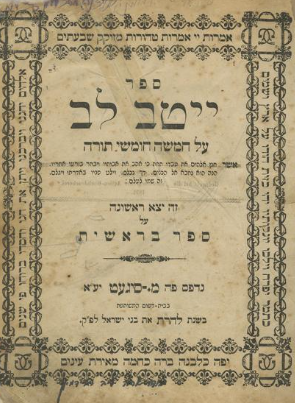
Yitav Lev is an acronym for Yekutiel Yehudah (Zalman Leib) Teitelbaum of Sziget, known as the  (1808–83). 

Introduction

This article, based extensively on the research by Professor Benjamin Brown[1] deals with the paradoxical idea of “holy sin” or “aveirah lishma”- where sometimes it is considered a mitzvah to sin - as found in some kabbalistic and Chassidic thought.

Sunday, 6 February 2022

370) Did the Mitnagdim create a counterpart to the Chasidic model of a Rebbe?


Yoreh Deah with Biur haGra

Introduction

Mitnagdim, or opponents of the Chasidic movement founded by the Baal Shem Tov in the early eighteenth century, have generally emerged relatively unscathed by accusations of exaggerated veneration of their Mitnagdic rabbinic leaders.[1] This article, based extensively on the research by Professor Alan Nadler[2] explores the notion of a Mitnagdic counterpart to the Chasidic model of veneration of their rebbes.

‘Decline of the generations’ (Yeridat hadorot) - the Mitnagdic argument against Chasidism