Menu

Showing posts with label Rationalism and mysticism. Show all posts

Sunday, 19 July 2026

562) Was Maharal of Prague a philosopher or a veiled mystic?

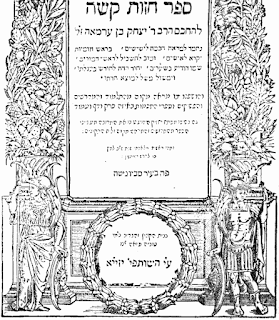
Tiferet Yisrael by Maharal of Prague. First edition, Venice 1599

Introduction

This articlebased extensively on the research by Dr Leore Sachs-Shmueli and Eynel Kapachexamines the question of whether the Maharal of Prague  (1512-1609) was a philosopher or a Kabbalist. The Maharal has long been the subject of much scholarly debate over his relationship to Kabbalah. This new research situates Maharal as a discreet Kabbalist who hid his deep mystical views behind a veil of philosophy. 

Sunday, 12 July 2026

561) Maimonidean philosophy as a form of rationalist mysticism?

The Kabbalistic Eitz Chaim as depicted in an early 18th century diagram from the Klau Scrolls Collection showing the complicated mystical path to unio mystica.

Introduction

This articlebased extensively on the research by Professor Gideon Freudenthalexplores the possibility of a unio mystica (mystical union) attainable through Maimonidean philosophic and rationalist endeavours. This rationalist unio mystica parallels (and might even surpass) the unio mystica described by the mystics and Kabbalists. If this claim holds, then it is not only the mystics who can, allegedly, experience unio mystica, but also the rationalists. Yet, both states of unio mystica are defined very differently, as one is mystically ecstatic while the other remains purely intellectual. 

Sunday, 15 March 2026

546) Jewish Mystics and Rationalists seeking Islamic Fatwas during the Maimonidean Conflicts


Ben Ezra Synagogue in Cairo

 Introduction

This article seeks to explore how thirteenth-century Jews often sought Fatwas (religious edicts) from Islamic courts to intervene during the intense period of Maimonidean Conflicts. These Conflictsalso known as the Maimonidean Controversieserupted after Maimonides’ passing in 1204, and were more like Jewish civil wars between the Maimonidean rationalists and the emerging mystics, with the Zohar first published eighty-six years later in 1290, in Christian Spain. The mystical opponents of Maimonides were often backed by Christian authorities such as the Dominicans, Franciscans and even King James I of Aragon [see: Kotzk Blog: 263) THE POLITICS BEHIND THE PIETY - BRINGING THE BATTLE INTO THE SIDDUR:]. 

Sunday, 21 December 2025

535) Suspending Judaism between depth and accessibility: Maimonides and Yeshaya of Trani

Piskei haRid and Piskei haRiaz. Rid (grandfather) and Riaz (grandson) published together in one volume, although their worldviews were very different.

Introduction

This article—drawing extensively on the research of Professor Marc Shapiro[1]—asks whether the Italian commentator and Talmudist, R. Yeshaya di Trani (known as Riaz) had a larger influence on future Judaism than Maimonides. Riaz was one of the rabbis who vigorously opposed Maimonides during the Maimonidean Controversies that consumed the rabbinic world in the centuries after Maimonides’ passing in 1204. It seems that the rabbis were not ready for the radical expansiveness of Maimonidean thought, and under the leadership of Riaz—the great antiMaimonidean polemicist—refused to allow Judaism to be subjected to philosophical creed or inquiry. Maimonides’ towering philosophical system threatened to redefine Judaism as a religion of creed and rational inquiry. Not all rabbis were prepared to accept this radical shift, and Riaz emerged as one of the most forceful voices of resistance, rejecting the binding nature of Maimonides’ Thirteen Principles of Faith as well as his rationalism. Instead, he argued for a simpler, unsophisticated and non-dogmatic faith based solely on Halachic observance. 

Sunday, 30 November 2025

532) Dialogues of vision: How we view Maimonides and how he might view us (Part II)


Secrets of the Guide by Dr Micha Goodman

How Maimonides might view us

Introduction

Part I examined the reception of Maimonidean thought in rabbinic Judaism. Part II now turns the focus on its head and examines, theoretically, how Maimonides might view contemporary Judaism as we know it. 

We begin with an overview of the essence of Moreh Nevuchim (Guide for the Perplexed) in an attempt to understand what it means by ‘secrets.’ 

‘Secrets’

There are two bodies of knowledge that Maimonides describes as Maaseh Bereishit and Maaseh Merkavah, which together form the Pardes (Orchard of esoteric wisdom) into which the four sages entered (b. Chagiga 14b). This knowledge (yeda), he maintains, once existed among the prophets and sages until a tragedy occurred, and that knowledge was lost. Maimonides understands a real prophet asnot someone who experiences visionsbut rather as a composite of perfected intellect, ethics and ability to imagine (Goodman 2015:39). Maimonides believed that the greatest loss to Judaism was not the destruction of the Temple or its rituals, but the loss of knowledge. Maimonides (Introduction to Moreh Nevuchim, section 3) writes that he managed to re-establish the hidden secret that our Masoret (Tradition) had lost. He did this, not through revelation or prophecy but through the capacity of the mind. 

Saturday, 25 October 2025

527) Neoplatonic echoes in Chassidic Mysticism


Raphael's fresco, School of Athens, painted around 1509.

Introduction

This article explores the intellectual legacy of Abu Ya'qub Isḥāq ibn Sulaymān al-Israeli—also known as Yitzchak ben Shlomo haYisraeli (c.855–c.955)—a pioneering yet largely overlooked figure in early Medieval Jewish philosophy. Through a counterintuitive comparison between Yitzchak haYisraeli’s tenth-century philosophical writings and contemporary Chassidic thought rooted in Kabbalah, the study reveals an unexpected conceptual convergence between the two thought systems. 

Sunday, 14 September 2025

525) Tashlich, water and 'bribing' demons

Introduction

Although the Jewish world after Maimonides (1138–1205) gradually embraced a mystical ethos—particularly following the publication of the Zohar some eighty years after his death—his followers remained wary of the burgeoning mystical practices that took root within Judaism, often approaching them with scepticism, if not outright rejection. Drawing on rationalist principles and a commitment to biblical authenticity, Maimonides challenged many mystical rituals, which he saw as later additions rooted in superstition or non-Jewish origins. His opposition reflects a broader philosophical stance: that religious expression should be grounded in reason, ethical clarity, and Torah-based tradition. This articlebased extensively on the research by Rabbi Dr Israel Drazin[1]examines the Tashlich ceremony and attempts to understand Tashlich within the broader context of medieval Jewish thought and its Maimonidean/rationalist reinterpretation. 

Sunday, 17 August 2025

522) Italian letters: The battle over the Zohar

An 1847 letter by Shmuel David Luzatto, to the scholar Meir Halevi Letteris.

Introduction

This articlebased extensively on the research by Daniel A. Klein[1]examines the little-known polemic over Kabbalah between two great Italian rabbis of the nineteenth century. These rabbis were R. Shmuel David Luzzatto (known as Shadal, 1800-1865), a great-grandnephew of the famed R. Moshe Chaim Luzzatto (Ramchal), and R. Elia Benamozegh (1823-1900), the rabbi of Livorno (Leghorn). The two collided in written correspondence—not over Halachah, but over the soul of Judaism itself. Both were outspoken defenders of traditional Judaism, yet each understood its essence in profoundly different ways. 

Shadal emphasised the practical, ethical and rational core of Judaism, rejecting mystical elements like Kabbalah and particularly the Zohar. His approach was more material than ethereal in the sense of being grounded in practical, historical, linguistic, and moral realism. Benamozegh, on the other hand, was a mystic, a Kabbalist, a man who believed the Zohar was not only authentic, but essential. To this day, the Piazza Benamozegh in Livorno, Tuscany, continues to bear his name—a quiet but enduring tribute to the legacy of a man whose ideas once stirred fierce debate within Italian Jewry. 

Sunday, 23 February 2025

502) Moshe haGoleh of Kiev: a critical devotee of Avraham Ibn Ezra


An early manuscript of Moshe haGoleh's Kabbalistic work, Shoshan Sodot.

Introduction

This article ꟷ based extensively on the research by Professor Eric Lawee[1] ꟷ examines a little-known and somewhat neglected exegete and commentator, R. Moshe ben Yakov (1448-1520) who compiled a super-commentary (i.e., a commentary on a commentary) based on R. Avraham Ibn Ezra (1089-1164) who had preceded him by almost four centuries. Moshe ben Yakov is also known as Moshe haGoleh (the ‘exile’) miKiev.[2] 

Very few have ever heard of Moshe haGoleh, nor of the commentary he authored on Ibn Ezra entitled Otzar Nechmad, but he had some interesting things to say about Ibn Ezra and his relationship to Halacha, and to his 'opponent' Rashi. Moshe haGoleh also shed some light on the existence of diverse Rashi manuscripts. Additionally, he embarked upon a mission to convert Karaites to Rabbinic Judaism. Surprisingly, although Moshe haGoleh was an outspoken supporter of the rationalist Torah commentary of Ibn Ezra and engaged in the sciences and astronomy, he personally remained a Kabbalist. As an exegete, he was able to maintain a level-headed and even critical approach towards his ‘rabbi,’ Ibn Ezra. He is the only known Kabbalist to have written a super-commentary on Ibn Ezra. Yet, he remains: 

Sunday, 12 May 2024

471) Tzafnat Paneach – a ‘counter Rashi’ commentary

Extract from a 1364 manuscript of Tzafnat Paneach by R. Eleazar Ashkenazi

Introduction

This article based extensively on the research by Professor Eric Lawee[1] − is divided into three parts:

Part 1 is a brief presentation of how the early Rashi texts were surprisingly diverse, and only emerged in the ‘standard’ form as we know them today at around the sixteenth century.

Part 2 looks at the early rabbinic reception of the Rashi texts.

Part 3 discusses and examines extracts from a little-known fourteenth-century ‘counter commentary’ to Rashi’s commentary. This ‘counter commentary’ was authored by R. Eleazar Ashkenazi, a Maimonidean rationalist, and entitled Tzafnat Paneach (Revealer of Secrets). 

Sunday, 18 February 2024

461) Maimonides unplugged


Recently discovered text in Maimonides' handwriting

Introduction

This article – based extensively on the research by Professor Menachem Kellner[1] penetrates directly into the thought of Maimonides. It offers a no-holds-barred approach to pure Maimonidean ideology as interpreted by Kellner, a recognised authority on Maimonidean thought. 

Most Torah lectures, and Halachic decisions reference Maimonides, yet astoundingly very few of the presenters of those forums are always aware of how Maimonides (Rambam) actually viewed Judaism. Not surprisingly, then, many will find Kellner’s research into Maimonidean thought to be perplexing if not perilous to the traditional ideas they cherish and hold dear. 

Sunday, 14 January 2024

457) “Religion – the greatest cause of wars” (Gersonides)


Torat haMelech published in 2009

Introduction

This article based extensively on the research by Professor Menachem Kellner[1] dating back to 2014 examines some extremist contemporary approaches to modern Jewish messianism. Kellner argues, instead, for a more rationalist approach to messianism, along the lines of Maimonides’ natural Messiah and his unusual vision of a non-supernatural messianic era and eschatology. 

If Gersonides[2] is correct in his assertion that religion is the greatest cause of wars, then various forms of messianism and eschatology must surely be a significant component thereof. 

Sunday, 17 December 2023

456) The power (and strategy) of maintaining secret religious knowledge


Introduction

Over and above the traditional, theological and Halachic considerations of Judaism, one cannot help but notice an apparent increase in the use of the word ‘power’ that gets appendaged to almost every contemporary religious discourse. If a certain day falls close to Shabbat, for example, there is an extra power to that day. Tzedaka is no longer a mitzva or chiyuv or an important social responsibility, but a means of attaining power. This strategy is often employed by fundraisers. Local Challa Bakes and Amen Parties become powerful antidotes capable of negating crises on an international, universal and cosmic scale. Powerful days, events, times and prayers have taken the place of holy, Halachic and auspicious times and practices. 

Sunday, 3 December 2023

454) Reconstructing the story of a Maimonidean student:


Introduction

This article based extensively on the research by Dr Reimund Leicht examines the story of R. Yosef ben Yehuda ibn Shimon, a student of Maimonides (1138-1204).[1] He could not have been an insignificant student because Maimonides chose to dedicate his philosophical work, Moreh Nevuchim (Guide of the Perplexed), to him. Very little is known about Yosef ibn Shimon. However, based on available historical evidence, Leicht reconstructs his life story and shows how he may have played a pivotal role in supporting his teacher during the Maimonidean Controversies that broke out after the passing of Maimonides. We are also presented with a fascinating window into some details about Maimonides the individual, and some of his practical directives about rabbinic independence and not teaching Torah for money. 

Sunday, 2 April 2023

424) Avraham Ibn Chasdai's references to 'a certain Chacham'


The thirteenth-century Moznei Tzedek by R. Avraham bar Chasdai,

Introduction 

I have based parts of this article on the research presented in ‘Judaism Adventures,’ and have additionally included some of the original Hebrew texts as well as other observations. For contextualisation, I have drawn on Peter Cole’s The Dream and the Poem.[1] 

Sefer Moznei Tzedek is a fascinating thirteenth-century work by R. Avraham bar Chasdai, also known as Ibn Chasdai, which gives us a rare window into rabbinical writings from around the time of Maimonides. Like Maimonides, Ibn Chasdai quotes Aristo (Aristotle) and he also is well-acquainted with Islamic teachings. He even cites sections of the Quran. 

Ibn Chasdai, was a staunch follower of Maimonides, and fought against R. Yehuda ibn Alfakhar and R. Meir haLevi Abulafia to withdraw their opposition to the Moreh Nevuchim (Guide for the Perplexed). This is interesting because Ibn Chasdai went on adapt or translate a work by the Islamic mystic, al-Ghazali, which we shall soon explore. 

Sunday, 6 March 2022

374) Stagnation in the inquiry into reasons for the commandments


 R. Shlomo ibn Aderet, El Rab d'España (The Rabbi of Spain) 1235-1310.


Introduction

It is sometimes of great benefit to view theological ideas and concepts within their historical context. This way, one would not mistakenly think that the idea or concept has always been there since antiquity. So, for example, when it comes to the notion of ta’amei hamitzvot, or reasons for the commandments - whatever one’s personal view on the matter is - it does help to realise that it was only as late as around the fourteenth and fifteenth centuries that the idea developed that the reasons for the mitzvot are beyond human comprehension. Until that time, it was quite common for rabbis to give rational or logical reasons for the mitzvot. But then the theology changed and the preferred approach became one of ‘transcendence’ whereby the reasons behind the Torah’s commandments were considered beyond human comprehension.

Sunday, 20 February 2022

372) R. Yitzchak Arama and the subtle demise of Jewish rationalism


Introduction

Many people, including rabbis, are surprised to discover that the concept of a rationalist Maimonidean Judaism exists. Maimonides’ thought is not the Maimonides of the Mishna Torah compiled around 1180 which many are familiar with (and which, by Maimonides’ own description, was just his summary of the Talmud) - but rather the philosophical Maimonides of the Moreh Nevuchim or Guide of the Perplexed, compiled later in 1190. The personal hashkafa or worldview of Rambam can only be seen in the latter work. Although Rambam passed away about eighty years before the Zohar was first published in 1290, he presented a strong rationalist worldview and deeply opposed the mystical thought that was brewing during his lifetime. The mystics repressed his rationalist ideology during the following few centuries when Kabbalah became dominant (and they continue to do so today), and his rationalist thought was essentially eradicated from Judaism.

Sunday, 23 January 2022

368) Ramban and his surprising references to ‘necromancy’


Ramban's Commentary on the Torah form an edition printed in Lisbon in 1489
(Marsh's Library Exhibits, accessed January 23, 2022, https://www.marshlibrary.ie/digi/items/show/528)
 

Introduction

Ramban (Nachmanides 1194-1270), known as the ‘father’ of Kabbalah, was a Spanish born rabbi from Girona, whose Catalan name was Bonastruc ça Porta (Mazal tov at the gate). This article, based extensively on the research by Professor Reimund Leicht[1] from the Hebrew University of Jerusalem, as well as Professor Dov Schwartz[2] from Bar Ilan University, deals with Ramban’s unusual usage of the word נגרמונסיא, or ‘necromancy’, which occurs four times[3] in his Commentary on the Torah. “Necromancy” is defined as “the act of communication with the dead in order to discover what is going to happen in the future”.[4] Although Ramban does not necessarily follow this exact technical definition of the term, he has some very interesting views on magic, idolatry, demons and astrology.

Sunday, 24 October 2021

355) R. Moshe Ibn Gigatila: The Psalms are just prayers


Introduction


In the previous post, The Psalms are not prayers, we saw how Rav Saadia Gaon held the unusual view that psalms may not be used as prayers and that, like the Torah itself they are meant only to be studied but not prayed. Psalms are not liturgy. According to Rav Saadia, the psalms were used as a strictly controlled and regulated ritual during Temple times, but never as liturgy (supplications or prayers). On this view, the psalms were never an ‘early prayer book’ as was claimed by the Karaite Jews. It is believed that Rav Saadia formulated his unusual and limited view on the function of the psalms, in reaction to the Karaites, who had rejected the Rabbanite siddur and used the psalms as their prayer book instead.

In this article, however, based extensively on the work by Professor Uriel Simon[1], we explore another unusual view of the psalms. This is the view held by R. Moshe Ibn Gigatila, who believed that that the psalms are indeed prayers - but nothing more than prayers. And because they are just prayers, they are not profoundly holy nor do they carry any prophetic or spiritually subliminal innuendo.

Sunday, 20 December 2020

306) THE ZOHARIC EMPHASIS ON AVRAHAM AS DISSEMINATOR OF NON-JEWISH MYSTICISM:


Sefer haZohar

Moreh Nevuchim

INTRODUCTION:

Almost every single version of the various narratives about Avraham contain the well-known moral lesson that he rejected the idolatrous and occultist practices of his birth culture and pioneered a new monotheistic path.

In this article, however, based extensively on the research of Professor Oded Yisraeli[1], we will explore a very different narrative of the same story. This narrative is from the Zohar which, according to Yisraeli, puts forward the view that:

[N]ot only did Abraham not separate himself from these practices but he himself was responsible for them[!]

Before we look at what the Zohar says in greater detail, let us first turn to the mainstream view as exemplified in the writings of Maimonides (or Rambam, 1135-1204):