Menu

Sunday, 6 March 2022

374) Stagnation in the inquiry into reasons for the commandments


 R. Shlomo ibn Aderet, El Rab d'España (The Rabbi of Spain) 1235-1310.


Introduction

It is sometimes of great benefit to view theological ideas and concepts within their historical context. This way, one would not mistakenly think that the idea or concept has always been there since antiquity. So, for example, when it comes to the notion of ta’amei hamitzvot, or reasons for the commandments - whatever one’s personal view on the matter is - it does help to realise that it was only as late as around the fourteenth and fifteenth centuries that the idea developed that the reasons for the mitzvot are beyond human comprehension. Until that time, it was quite common for rabbis to give rational or logical reasons for the mitzvot. But then the theology changed and the preferred approach became one of ‘transcendence’ whereby the reasons behind the Torah’s commandments were considered beyond human comprehension.

Sunday, 27 February 2022

373) Kabbalah – a product of the East or West?


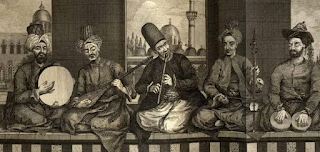
Jews and Sufis shared music traditions

Introduction

Kabbalah, until just a few decades ago, was generally understood in as originating within a Eurocentric context. It was believed to have emerged essentially from centres like Italy, Provence (southern France), Germany and Spain. In scholarly circles, this was the result particularly of the work by Gershom Scholem,[1] who was convinced of Gnostic origins to Kabbalah: He writes that it is:

surprising that the [Kabbalistic][2] doctrine…was deeply related to Gnosticism, but such are the dialectics of history” (Scholem 1941:286).

Sunday, 20 February 2022

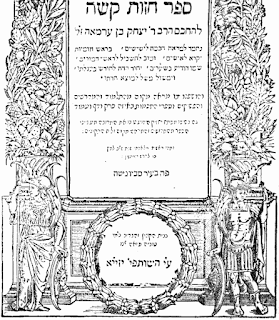
372) R. Yitzchak Arama and the subtle demise of Jewish rationalism


Introduction

Many people, including rabbis, are surprised to discover that the concept of a rationalist Maimonidean Judaism exists. Maimonides’ thought is not the Maimonides of the Mishna Torah compiled around 1180 which many are familiar with (and which, by Maimonides’ own description, was just his summary of the Talmud) - but rather the philosophical Maimonides of the Moreh Nevuchim or Guide of the Perplexed, compiled later in 1190. The personal hashkafa or worldview of Rambam can only be seen in the latter work. Although Rambam passed away about eighty years before the Zohar was first published in 1290, he presented a strong rationalist worldview and deeply opposed the mystical thought that was brewing during his lifetime. The mystics repressed his rationalist ideology during the following few centuries when Kabbalah became dominant (and they continue to do so today), and his rationalist thought was essentially eradicated from Judaism.

Sunday, 13 February 2022

371) ‘Tikla’ and the zoharic concept that sin can bring redemption


The potter's wheel gives shape to a lump of clay.

Introduction

This article, based extensively on the research by Dr Ruth Kara-Ivanov Kaniel[1] as well as Rabbi Moshe Miller[2], deals with the fascinating yet paradoxical notion in the Zohar of sin as a harbinger or precursor of redemption. The discussion revolves around the Aramaic word Tikla, which appears on two occasions in the Zohar.[3]

Sunday, 6 February 2022

370) Did the Mitnagdim create a counterpart to the Chasidic model of a Rebbe?


Yoreh Deah with Biur haGra

Introduction

Mitnagdim, or opponents of the Chasidic movement founded by the Baal Shem Tov in the early eighteenth century, have generally emerged relatively unscathed by accusations of exaggerated veneration of their Mitnagdic rabbinic leaders.[1] This article, based extensively on the research by Professor Alan Nadler[2] explores the notion of a Mitnagdic counterpart to the Chasidic model of veneration of their rebbes.

‘Decline of the generations’ (Yeridat hadorot) - the Mitnagdic argument against Chasidism

Sunday, 30 January 2022

369) Menachem Tziyoni’s kabbalistic writings on demonology


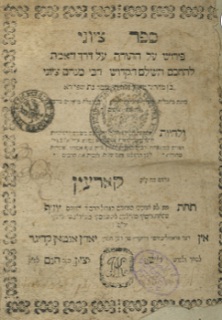
Sefer Tziyoni, Korets, 1785.

 Introduction

This article, following the theme of the previous post, further pursues the notion of demonology within Kabbalistic theology. I have drawn extensively upon the research by Professor Boaz Huss[1], a leading contemporary scholar in Kabbalah. This brief study will show just how far into the occult the mystical tradition is sometimes prepared to go.

Sunday, 23 January 2022

368) Ramban and his surprising references to ‘necromancy’


Ramban's Commentary on the Torah form an edition printed in Lisbon in 1489
(Marsh's Library Exhibits, accessed January 23, 2022, https://www.marshlibrary.ie/digi/items/show/528)
 

Introduction

Ramban (Nachmanides 1194-1270), known as the ‘father’ of Kabbalah, was a Spanish born rabbi from Girona, whose Catalan name was Bonastruc ça Porta (Mazal tov at the gate). This article, based extensively on the research by Professor Reimund Leicht[1] from the Hebrew University of Jerusalem, as well as Professor Dov Schwartz[2] from Bar Ilan University, deals with Ramban’s unusual usage of the word נגרמונסיא, or ‘necromancy’, which occurs four times[3] in his Commentary on the Torah. “Necromancy” is defined as “the act of communication with the dead in order to discover what is going to happen in the future”.[4] Although Ramban does not necessarily follow this exact technical definition of the term, he has some very interesting views on magic, idolatry, demons and astrology.

Sunday, 16 January 2022

367) The “Shevartzeh Chaseneh” or Black Wedding

 The Yizkhor bukh fun der Zhelekhover yidisher kehileh (Chicago, 1953) shows a Black Wedding taking place in Zelechów during the time of the Holocaust.
Introduction

This article explores the very strange practice of performing a Shevartzeh Chaseneh or Black Wedding at a Jewish cemetery. It entailed the conducting of a legal wedding ceremony between two people in the belief that such an event would appease the dead to intercede on behalf of the community and halt a crisis such as a typhus epidemic. I have drawn extensively upon the writings of Hanna Wegrzynek[1] who has researched this very strange yet quite common phenomenon and has traced it roots and origins.

Sunday, 9 January 2022

366) Changing perceptions of the “other”


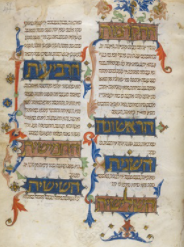
This manuscript is of the Hebrew translation from the original Arabic Guide of the Perplexed, translated by Samuel Ibn Tibbon (died c. 1230). It was produced in Spain, around 1350. 

Introduction

This article, based extensively on the research by Professor Menachem Kellner[1], examines various perspectives of the “other” in the writings of Maimonides and traces how these teachings were sometimes changed by later editors who attempted to “correct” the original Maimonidean texts. Kellner (2007:1) explains that the reason why later editors and copyists were keen to change the original Maimonidean texts was “to pull the sting of their universalism and make them accord with more widely accepted notions of Jewish separateness and superiority”.

Sunday, 2 January 2022

365) Leniencies in conversion or stringencies in avoiding assimilation?


Introduction

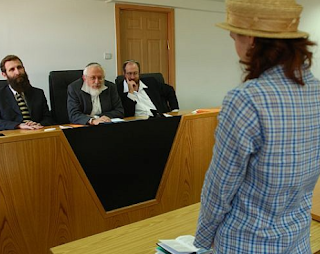
The discussion on conversion to Judaism has once again assumed a position of centre stage within Israeli and Jewish politics. This article explores a number of approaches as articulated by Professor Richard Hidary from Yeshiva University[1] in Part I; as well as some recent writings by Rabbi Eliezer Melamed, author of the Peninei Halacha series[2] in Part II.

Sunday, 26 December 2021

364) Who should lead – the rabbis or the representatives of the people?


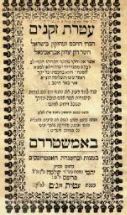
Ateret Zekeinim (Crown of the Elders): Abravanel's first main work defending the negative image of the biblical elders.

Part 1

Introduction

There is a fundamental difference of opinion between Maimonides (Rambam, 1135-1204) and Abravanel (1437-1508) as to who is entitled to lead the Jewish people. According to Rambam, it is Moshe (or the relative equivalent in subsequent generations, which we shall refer to as the “rabbis”); and according to Abravanel, it is the representatives of the people (which we shall refer to as the “elders”).

This article is based extensively on the research by Cedric Cohen-Skalli[1] although the adaptation of this debate to modern times is my own.

Sunday, 19 December 2021

363) Trying to define the theology of Abravanel


Introduction

The length, breadth and depth of classical rabbinic thought continues to fascinate and intrigue me unabatedly. One such rabbinic figure is that of Abravanel (1437-1508), who, the more one reads about, the more complicated a personality he becomes.

We noted in an earlier article that Abravanel is difficult to define as being either a rationalist or a mystic as he seems to vacillate between the two approaches. This article, based extensively on research by Professor Eric Lawee[1], explores Abravanel’s complexity even further.